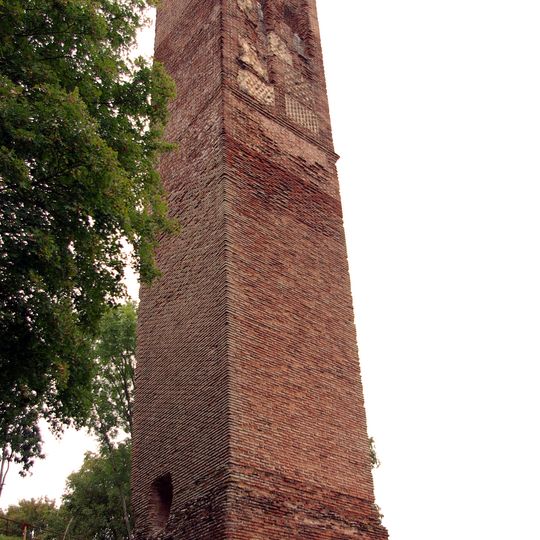
Pile de Cinq-Mars, Roman funerary monument in Cinq-Mars-la-Pile, France.
The Pile de Cinq-Mars is a solid ancient tower faced in narrow red and brown bricks, 29.60 m high (100 Roman feet), with a rubble core and twelve geometric panels set into the upper walls. It stands on a small artificially levelled terrace, 50 × 19 m, on the hillside at 60 m altitude, 1.5 km east of the village centre.
The tower was built in the second half of the 2nd or early 3rd century, probably as part of a larger funerary complex for a Turonian or Roman dignitary. In 2005, excavations found a podium, a building and a statue nearby, showing the pile was not isolated. It stands on a small terrace on the hillside, not on the plateau.
The name Cinq-Mars most likely derives from Sanctus Medardus (Saint Médard), as written in texts from the 10th to the 16th century; Rabelais mentions "sainct Mars auprés de Langés" in the 1542 Gargantua. Explanations by five pillars, five warriors (quinque martes) or Quintus Marcius are unconvincing. The monument has been famous since Rabelais alluded to it in chapter XV of the 1534 edition.
The tower is visible from the road and can be viewed from outside without any special effort, though the path up to the plateau can be steep in places. Coming during daylight hours gives the best view of the decorative panels on the outer walls.
The tower stands 29.60 m high, exactly one hundred Roman feet, and its facing is estimated to contain 104,000 bricks laid in 580 courses. Brick-making continued in Cinq-Mars-la-Pile until the 1930s, so the bricks may have been fired locally. No putlog holes pierce the walls: the scaffolding stood against the structure rather than being anchored in it.
The community of curious travelers
AroundUs brings together thousands of curated places, local tips, and hidden gems, enriched daily by 93,602 contributors worldwide.