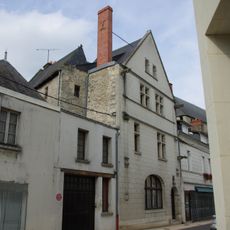
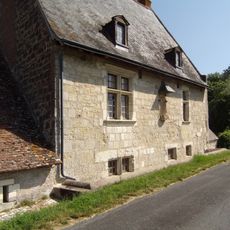
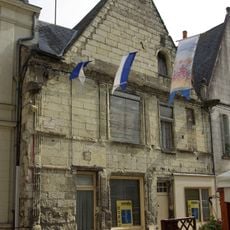
Château de Cinq-Mars-la-Pile, Medieval fortress in Cinq-Mars-la-Pile, France.
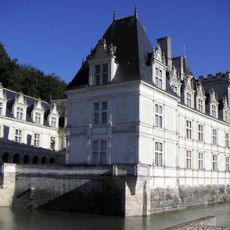
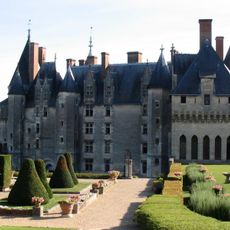
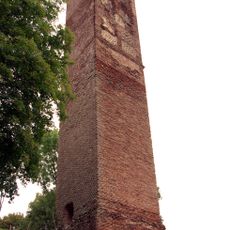
Château de Cinq-Mars-la-Pile is a fortress in France with two round towers from the 12th and 13th centuries. These towers are connected by wide moats that were rebuilt during the 16th century, showing how the defensive structure evolved over time.
The fortress began as a medieval structure and underwent modifications during the Renaissance, particularly in the 16th century. In 1642, Cardinal Richelieu ordered its destruction after the execution of Henri de Ruzé d'Effiat, a favorite of King Louis XIII.
The castle is privately owned and not open to visitors, so the towers and guard house can only be seen from outside. The name Cinq-Mars comes from the seigneurie of Saint-Médard, held by the same lords since the 11th century. The 15th-century cylindrical tower once had a stone spiral staircase letting the lords descend from the castle to the priory joined to the church.
The castle is privately owned and not open to visitors; the towers, moats and three-arched bridge can only be seen from outside. The remains stand in the commune of Cinq-Mars-la-Pile, in Indre-et-Loire, and are listed as a monument historique.
The cylindrical tower above the moat in the corner of the Eperon held a stone spiral staircase that let the lords descend from the castle to the priory attached to the church. The Eperon itself, a triangular spur on the south-east, was built or remodelled in the 16th century together with the moats, and its salient angle carries a bartizan.
The community of curious travelers
AroundUs brings together thousands of curated places, local tips, and hidden gems, enriched daily by 93,096 contributors worldwide.