Agen aqueduct, Navigable aqueduct in Le Passage and Agen, France
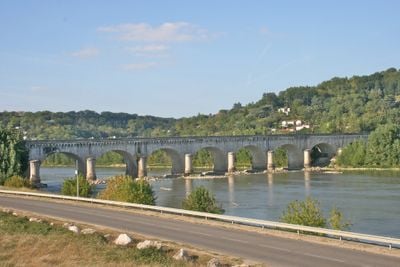
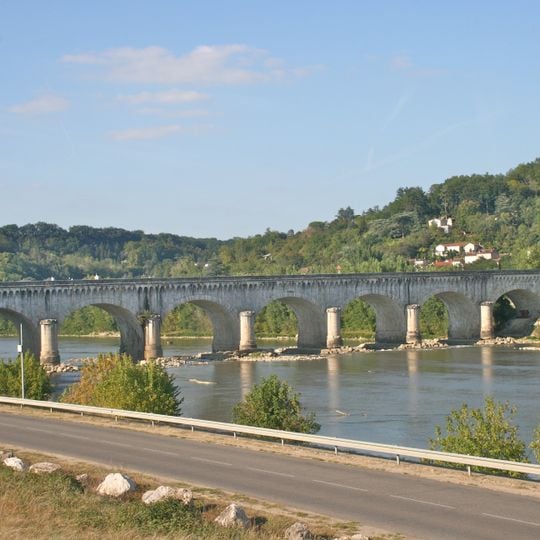
The Agen aqueduct is a dressed stone masonry structure carrying the Canal de Garonne over the Garonne between Agen and Le Passage. It has 22 piers and 23 round arches with cutwaters, a total length of 539 metres and a channel 8.82 metres wide and 2.70 metres deep.
Work on the structure began in 1839 and was completed in 1849 after overcoming several delays during construction. An engineer named Jean-Baptiste de Baudre supervised the building of this stone bridge for boats.
The bridge is named after Agen, the town it serves, not after the Garonne it crosses. Since 1981 its downstream end has marked the limit of the national nature reserve of the Alose spawning ground, and the two waiting basins with their locks frame the crossing.
The passage for boats is tight, and vessels must wait for clearance to cross since multiple boats cannot pass at the same time. It is important to allow time and prepare for possible waits if planning a crossing.
The stones used in construction were chosen from the Quercy region, an area known for stone quarrying and quality materials. At its completion, it was the longest aqueduct of its kind in France, a technical achievement visitors can still appreciate today.
The community of curious travelers
AroundUs brings together thousands of curated places, local tips, and hidden gems, enriched daily by 93,525 contributors worldwide.