Manoir de Kerazan, Manor house in Loctudy, France.
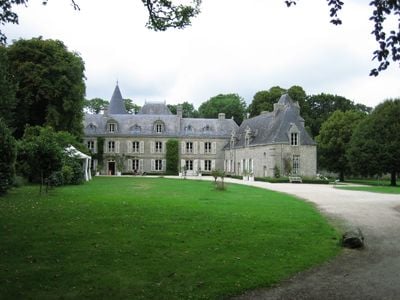
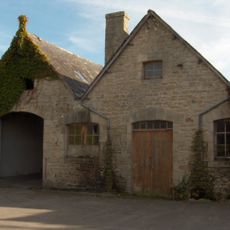
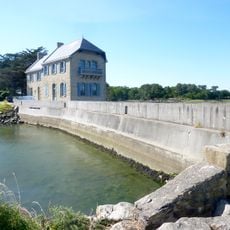
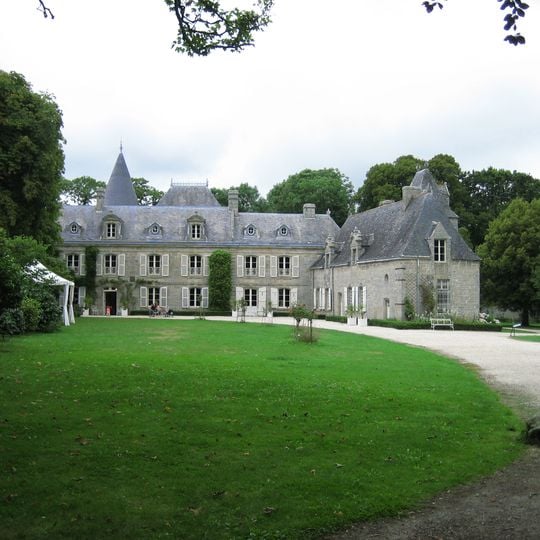
Manoir de Kerazan is a two-wing manor house between Pont-l'Abbé and Loctudy, built of granite and slate. Its east wing survives almost unchanged from the 16th century, while the rest dates from the 18th and 19th centuries. The north facade has rusticated corner pilasters and the carved coat of arms of the Counts of Rosmorduc, and a round stair turret with a conical roof stands against it.
The Kerfloux family built a fortified residence here at the end of the 16th or start of the 17th century; the east wing survives from that campaign. Louis de Rosmorduc added a storey and enlarged the windows in the 1760s, and the estate was sold as national property on 19 July 1794 for 46,000 livres to the architect Louis Derrien. Joseph-Georges Astor bequeathed it to the Institut de France in 1928, on condition that a museum and an embroidery school be set up.
The last room displays the Quimper faience collection begun by Joseph Astor and enlarged by his son Joseph-Georges, who bought pieces by his friend Alfred Beau. Its centrepiece is a 1.20 m faience cello painted by Beau, the only one of its kind. The manor holds the largest group of Beau's works.
The manor is open from Easter to the end of September; the rest of the year it is closed. The visit covers the ground-floor rooms and the Quimper faience collection, and the five-hectare park with its dry moat and canal can be walked separately. The site lies between Pont-l'Abbé and Loctudy, a few kilometres north of Loctudy.
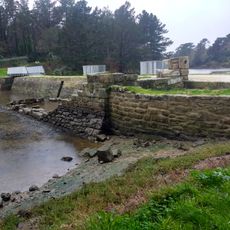
The five-hectare park was laid out in 1765 and later turned into an English landscape garden from a baroque one, of which a boxwood garden and a chestnut-lined avenue remain. A hook-shaped moat, once used for water games, now shelters ducks and frogs, and Chinese windmill palms grow among the beeches and apple trees.
The community of curious travelers
AroundUs brings together thousands of curated places, local tips, and hidden gems, enriched daily by 94,497 contributors worldwide.