Larrun, Mountain summit in Basque Country, France
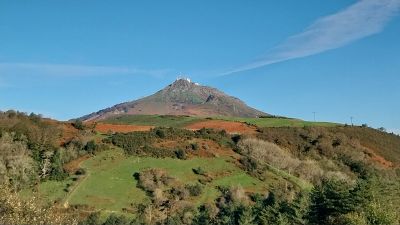
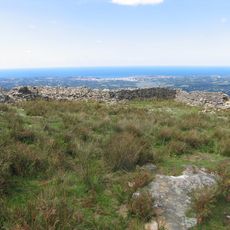
Larrun is a summit of fractured greyish-brown sandstone in the western Pyrenees, on the French-Spanish border. Rough stepped slabs and boulders rise from grassy lower slopes to a flat-topped crest, where white- and red-walled buildings and antennas stand, including a red-and-white striped mast and a lattice tower. The upper slopes carry short green vegetation broken by grey rock, with rust-brown and tan flanks cut by gullies below.
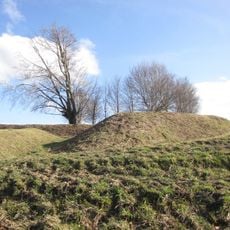
Cromlechs, tumuli and dolmens on its slopes show human presence since prehistory. In the early 17th century, magistrate Pierre de Lancre was convinced witches gathered on the summit, the akelarre or "moor of the goat". Empress Eugénie, staying at Biarritz, started the fashion for excursions to the mountain.
The Basque name Larrun means "place of pastures", from larr- (pasture or moor) and hun(e) (place); the French form La Rhune is a faulty split of that name. In the early 17th century the Bordeaux magistrate Pierre de Lancre was convinced witches gathered on the summit, and the mountain features in Basque legends, including that of a seven-headed serpent, lehensugea, said to live inside it.
From the French side, a rack railway reaches the summit without requiring hiking. Alternatively, various hiking trails offer different levels of effort.
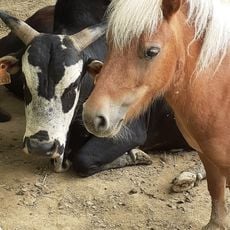
For centuries, sheep and ponies have grazed on the mountain's meadows, shaping its appearance and ecology. Local shepherds continue this traditional practice in the same way as their predecessors.
The community of curious travelers
AroundUs brings together thousands of curated places, local tips, and hidden gems, enriched daily by 93,470 contributors worldwide.