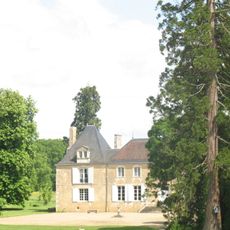
Abbaye de Nouaillé-Maupertuis, Medieval abbey in Nouaillé-Maupertuis, France.
Abbaye de Nouaillé-Maupertuis is a monastery set in a valley along the Miosson River with fortified walls, towers, and moats surrounding the complex. Three separate crypts lie beneath the Romanesque church, each revealing architectural styles from different periods.
Monks from Saint-Hilaire de Poitiers settled by the Miosson around the late 7th century; from 808 they adopted the Benedictine rule and broke away from Saint-Hilaire. Abbot Godelin built a new church with a crypt for the relics of Saint Junien, translated in 830, which gave the abbey its name. In the 11th century, under Abbot Constantin and the protection of the counts of Poitou, the church gained a four-bay nave and one of the earliest transepts in Poitou. In 1569 the Protestant army of Admiral Coligny pillaged and burned the abbey, destroying the choir, cloister and dormitories.
The abbey church took the name Saint-Junien after the relics of Junien, founder of the Poitevin monastery of Marié-Lévescault, were transferred there in 830. His Carolingian sarcophagus now stands at the back of the choir, painted with eagles inside three pearl-bordered medallions, a design drawn from Eastern textiles.
Access to the monastery is free and visitors can explore the Romanesque church, medieval garden layouts, and architectural elements spanning different eras. It is useful to allow time to visit the crypts beneath the church and view the fortified structures surrounding the grounds.
The Carolingian sarcophagus of Saint Junien, kept at the back of the choir, preserves painted decoration inspired by Eastern textiles, showing eagles inside three pearl-bordered medallions. Carved interlace plaques from the early 9th century are set into the walls of the crypt built under Abbot Godelin to hold the tomb.
The community of curious travelers
AroundUs brings together thousands of curated places, local tips, and hidden gems, enriched daily by 94,657 contributors worldwide.