Hypogée des Dunes, Underground chapel and burial site in Poitiers, France
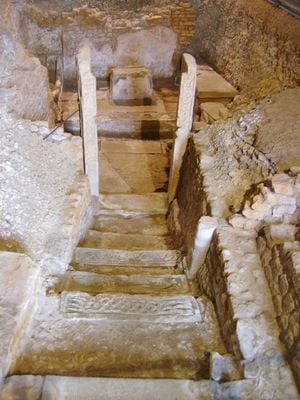
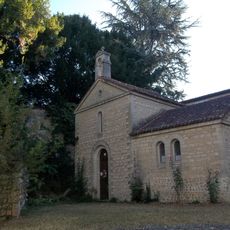
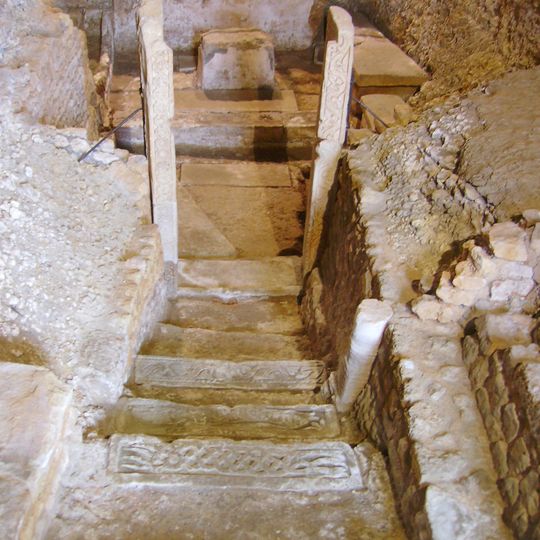
The Hypogée des Dunes is a small Merovingian funerary chapel in Poitiers, built by the abbot Mellebaude as his own burial place. It was divided into two spaces of similar size, separated by a step carved with rosettes and a Latin inscription, and was probably barrel-vaulted and covered with tiles. A stone staircase with carved bands and circular motifs leads down to the platform; an arcosolium once held Mellebaude's tomb, and an altar survives at the back.
This site originated in the early medieval period and served as a burial place during the Merovingian era, roughly from the 5th to 8th century. It remained hidden for centuries until Father Camille de la Croix uncovered it in 1878, bringing this ancient burial ground into scholarly awareness.
The stone carvings and wall paintings inside show how early medieval Christians expressed their faith through craftsmanship and art. These works let visitors experience the religious world of that time directly.
This site is normally closed to visitors and opens only on a few specific days each year through guided tours. You should check ahead and plan early to secure a spot on one of these rare group tours.
The steps leading into the chapel carry carved Christian emblems such as snakes, fish and ivy, resembling early medieval chancel screens. The stones may be reused pieces whose origin is unknown, and glass cabochons from the Roman-era necropolis are set into slabs inscribed with biblical texts and Mellebaude's declaration of trinitarian faith.
The community of curious travelers
AroundUs brings together thousands of curated places, local tips, and hidden gems, enriched daily by 94,383 contributors worldwide.