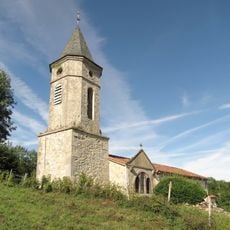
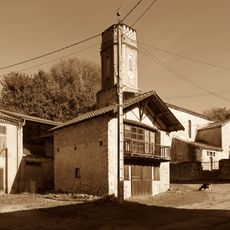
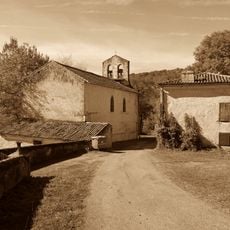
Abbaye de Combelongue, 12th century Romanesque abbey in Rimont, France.
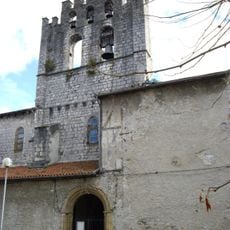
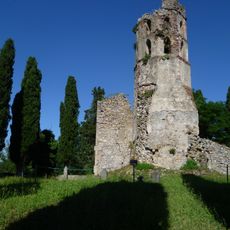
Abbaye de Combelongue is a Premonstratensian abbey founded in 1138 in Rimont, Ariège. Its Romanesque walls are built entirely of pink brick, unusual in a region where stone is common. The exterior shows reddish and tan brick courses with grey weathered patches, a tall arched recess with a round-headed window filled with pierced stone lattice, and a small round opening high on one wall.
The monastery was founded in 1138 and sat on major pilgrimage routes heading toward Santiago de Compostela. King Louis VII visited in 1154 during his journey to Compostela.
The abbey belongs to the Premonstratensian order and is the only one in the former diocese of Couserans. Its name, Combelongue, refers to the long valley where it stands. In 1207 its abbot Navarrus d'Acqs, also bishop of Couserans, served as legate of Pope Innocent III and took part in the disputes between Catholics and Cathars at Montréal and at the colloquy of Pamiers.
The abbey stands in Rimont, in the Ariège, and is open to visitors in summer; renting the site is also possible. The gardens — medieval, Renaissance and French-style — the large nave, the open-air theatre, the orchard and the boxwood terrace are all part of the grounds. The site has held the Jardin Remarquable label since 2012.
The gardens are divided into two distinct styles, one medieval and one designed in the French manner. This layout holds official recognition as a Jardin Remarquable and shows how different periods coexist in a single space.
The community of curious travelers
AroundUs brings together thousands of curated places, local tips, and hidden gems, enriched daily by 94,657 contributors worldwide.