Tourcoing station, Historical railway station in Tourcoing, France
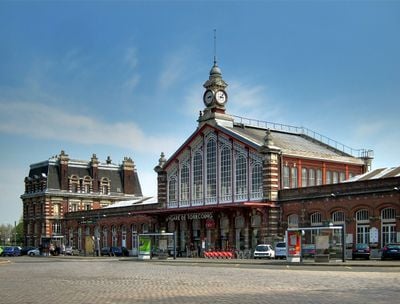
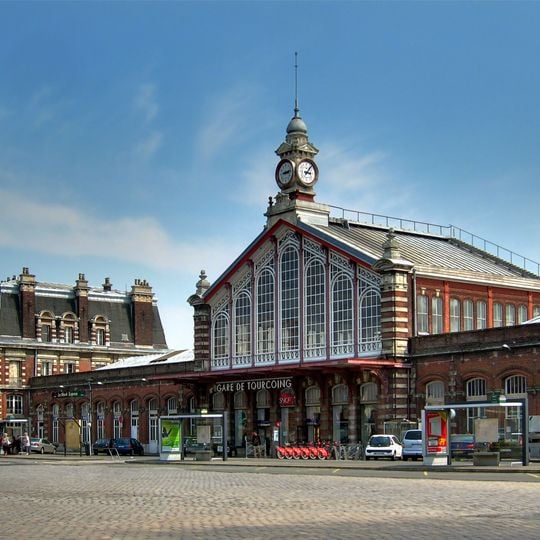
Tourcoing station is a railway facility in northern France with a symmetrical facade featuring large arched windows and stone decorative details across its entrance. The building functions as an active transportation hub with platforms that handle regular train services connecting the city to the surrounding region.
The first Tourcoing station opened on 14 November 1842 in the presence of the Duke of Nemours and Adolphe Thiers. Overwhelmed by traffic from the wool textile trade, it was replaced by the current building, planned in 1903–1904 by engineers Clément Ligny, Aumont and Vainey, who drew on Sidney Dunnett's Roubaix station; Dunnett died in 1895. The passenger building was listed as a monument historique on 28 December 1984.
The station's name appears in gold letters above the glass front, and the facade was composed by architect Clément Ligny to answer the trident-shaped square in front of it. One side pavilion once held a hotel, the other a post office; the station also had a buffet restaurant, a telegraph office and a customs post, as Tourcoing was an important border station.
The station sits at kilometre point 12.396 of the Fives–Mouscron line, 41 metres above sea level, a few minutes from the town centre on a square laid out in a trident shape. The main entrance opens onto this paved square, and the passenger hall leads directly to the platforms under the metal hall.
The station's facade was designed by architect Clément Ligny to answer a square laid out in a trident shape. The plans were drawn up in late 1903 and early 1904 by Ligny with engineers Aumont and Vainey, who took the neo-Louis XIII design of Roubaix station and added a paved courtyard. Sidney Dunnett, long credited with the building, died in 1895, before the project existed.
The community of curious travelers
AroundUs brings together thousands of curated places, local tips, and hidden gems, enriched daily by 94,039 contributors worldwide.