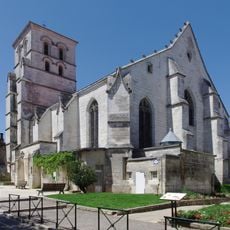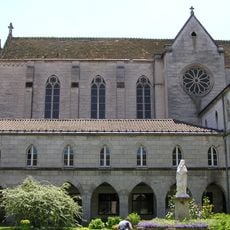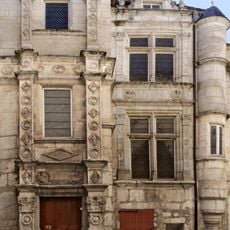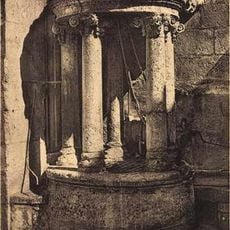
Abbey of Saint-Cybard, Romanesque abbey ruins in Angoulême, France.
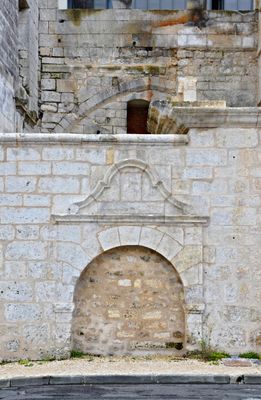
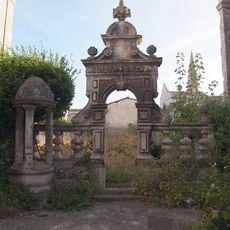
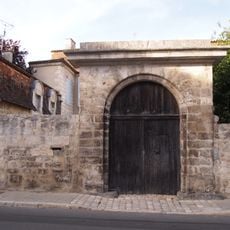
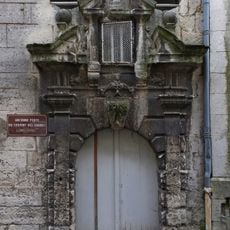
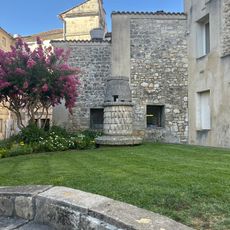
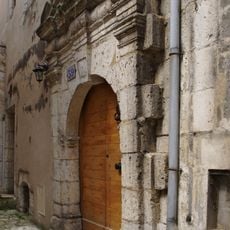
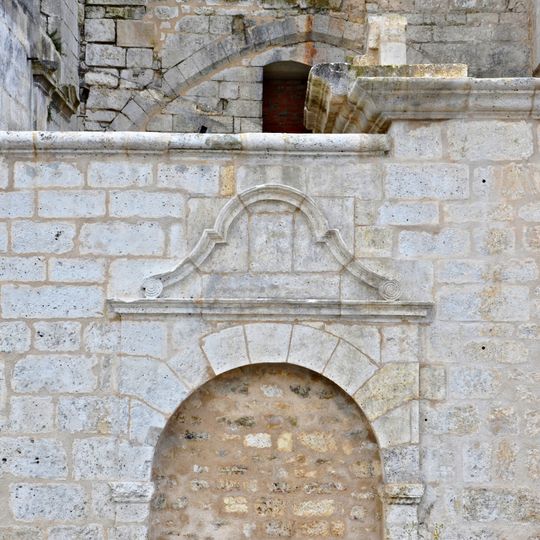
The Abbey of Saint-Cybard in Angoulême preserves the north side of its abbey church and sections of the chapels at the northwest corner of the former cloister. The surviving masonry includes a round-headed arch filled with rough stones, a projecting stone ledge, and above it a curved pediment with scrolled ends. A second arched opening appears higher up.
The monastery was established in the 6th century and later endured raids by Viking attackers. In the 1500s, Protestant forces damaged much of the complex during religious conflicts in the region.
The site takes its name from Saint Cybard, the hermit who lived in a cave beneath Angoulême's northern rampart in the 6th century. Marie de Médicis visited in March 1619 and had part of the chapel floor broken open, removing an iron chest of bones and relics. The abbey later became a paper mill and brewery before housing the Cité internationale de la bande dessinée et de l'image from 1984.
The site is located in central Angoulême and is easily reached on foot from nearby streets. The remains are freely accessible and require no special preparations to explore, though the walls are modest in height and give only a limited view of the original layout.
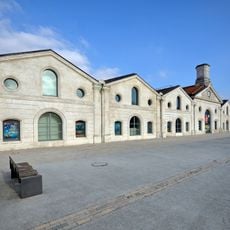
In the courtyard of the abbey lodging, rebuilt between 1640 and 1688 under Abbot Henry de Reffuge, a metal roof frame designed by Édouard Warin in the 19th century still stands. It survives from the years when the former monastery housed a paper mill and a brewery, before the site became the Cité internationale de la bande dessinée et de l'image.
The community of curious travelers
AroundUs brings together thousands of curated places, local tips, and hidden gems, enriched daily by 94,657 contributors worldwide.