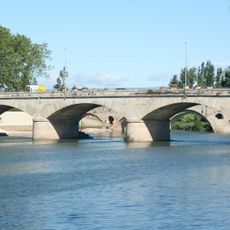
Orb Aqueduct, Navigable aqueduct in Béziers, France.
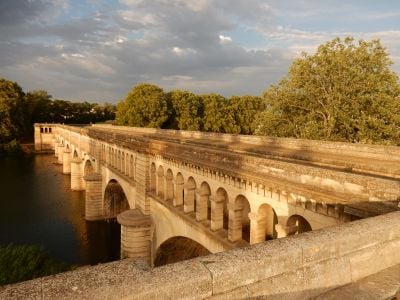
The Orb Aqueduct crosses the Orb River with seven stone arches, spanning 240 meters and standing 12 meters tall. The structure contains a masonry trough sealed with concrete that carries the canal water above while allowing the natural river to flow beneath it.
Before the aqueduct opened, Canal du Midi boats crossed a short stretch of the Orb itself, which was unpredictable and sometimes dangerous; in 1779 floods made it impassable for seventeen days. Schemes to bypass the river failed in 1739 and 1756. In April 1854 the Canal Company's chief engineer, M. Magues, drew up the present design, approved by decree of Napoleon III in June 1854; work was completed by May 1856 and the aqueduct opened in 1858.
The aqueduct takes its name from the Orb, the river it crosses, and is also called the Béziers canal bridge. Its 1854 design by chief engineer Urbain Maguès replaced the old route through the Fonserannes staircase's eighth chamber and the Notre-Dame lock, which were left unused. The concrete seal in the masonry trough was renewed in 1951.
Two parallel towpaths along the sides allow visitors to cross the structure and watch boats pass through the single-lane water channel. Access is straightforward and the paths offer viewpoints over the river below.
The aqueduct's two lower arcaded walkways, running beneath the water trough, are closed to the public and kept for maintenance only. The concrete seal inside the trough was replaced in 1951, but the rest of the 1858 stone structure remains as built.
The community of curious travelers
AroundUs brings together thousands of curated places, local tips, and hidden gems, enriched daily by 94,107 contributors worldwide.