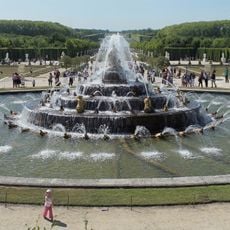
Bosquet de l'Encelade, Garden fountain grove in Versailles, France.
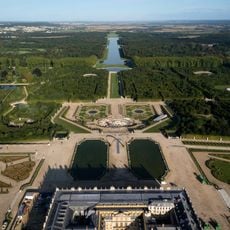
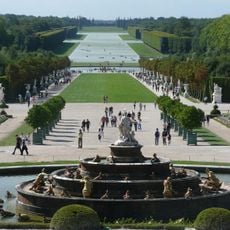
Bosquet de l'Encelade is a wooded garden room in Versailles with a lead sculpture of a giant emerging from rocky terrain at its center. The composition features eight auxiliary fountains arranged around an octagonal lawn, creating a balanced and enclosed garden space.
Created in 1675 by Louis XIV and laid out by André Le Nôtre between 1675 and 1678, the bosquet received an octagonal lawn ring and eight rocaille fountains in 1678. In 1706 Jules Hardouin-Mansart removed the trellis gallery, the small basins and the original slope, turning the enclosed space into an open crossroads. Pierre-André Lablaude restored it to its primitive state in 1998.
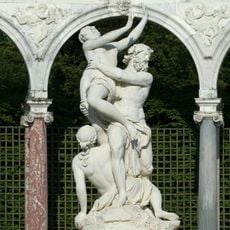
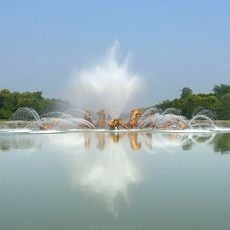
The gilded lead figure by Gaspard Marsy shows Enceladus, leader of the giants' revolt, crushed under rocks and turning into Mount Etna. Berthier made the rockwork around the basin to imitate volcanic lava. Some readings see in the myth an allusion to Louis XIV's victory over the Fronde, or to the fall of Fouquet.
This location sits within a quieter section of the palace gardens and is easily accessible by following the park pathways. It works well as a stop during a leisurely walk through Versailles, especially if you time your visit to catch a water show performance.
The fountain's jet reaches 78 pieds (25.74 m), the highest of all the fountains at Versailles. The sculptor Gaspard Marsy cast the gilded lead Enceladus, while Berthier made the rockwork imitating the lava of the volcano. Louis XIV's own handwritten garden guide, from 1702-1704, notes: "On passera par Lancellade où on ne fera qu'un demy-tour."
The community of curious travelers
AroundUs brings together thousands of curated places, local tips, and hidden gems, enriched daily by 93,481 contributors worldwide.