Park of Versailles, Royal gardens in Versailles, France
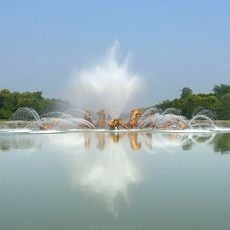
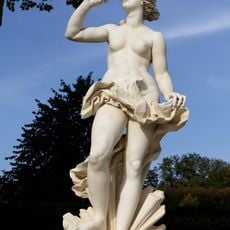
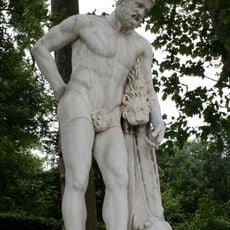
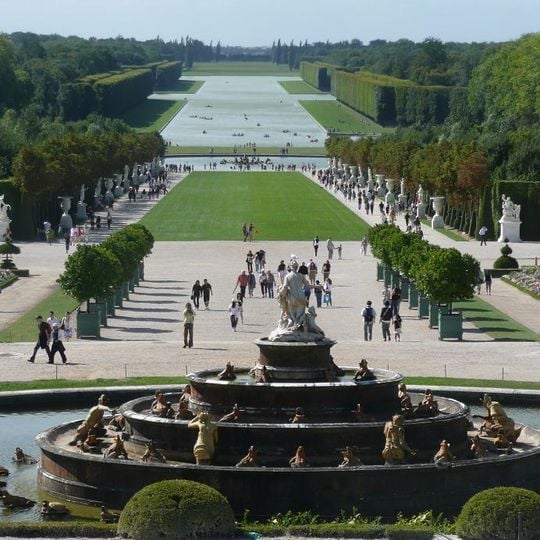
The Park of Versailles is an 815-hectare enclosed park west of the palace, laid out on a central axis. From the palace, a wide path descends past geometric beds to a large circular basin with a tall fountain jet, then continues to an oval pool with a white stone fountain and statue group. Beyond, a long rectangular reflecting pool climbs between clipped trees and rows of pale stone statues.
The gardens were created between 1661 and 1700 under King Louis XIV, who commissioned a landscape architect to establish new standards for European garden design. This work shaped garden culture across Europe for generations and made this location a model for royal estates everywhere.
The bosquets, called "green rooms" since Louis XIV's time, are enclosed by tall hedges that hide fountains, small gardens or green theatres. The Queen's Grove began in 1665 as Le Nôtre's labyrinth, later decorated with 39 fountains illustrating Aesop's fables for the education of the Dauphin; it was removed in 1778 and replaced by the present English garden.
The grounds are accessible year-round, though the best time to walk is during warmer months when all areas are open and weather is pleasant. Visitors should wear comfortable shoes since exploring the different sections requires a lot of walking.
The gardens once held up to 1,400 water jets and fountains, some hidden inside the groves. When Louis XIV ordered the Grandes Eaux, nearly 10,000 cubic metres of water were consumed in twelve hours. The hydraulic network was refined as work advanced, and the gardens are still maintained by about seventy gardeners today.
The community of curious travelers
AroundUs brings together thousands of curated places, local tips, and hidden gems, enriched daily by 94,043 contributors worldwide.