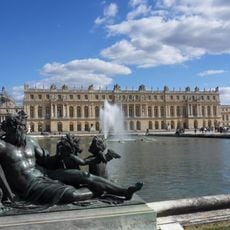
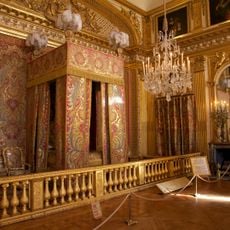
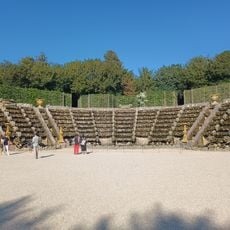
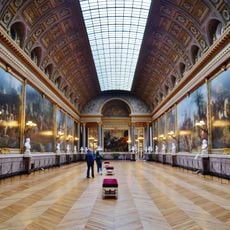
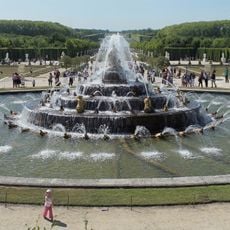
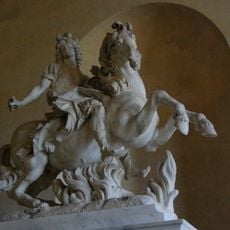
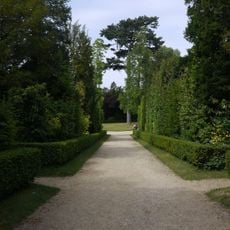
Latona Parterre, French formal garden in Versailles, France.
Latona Parterre is a garden in the east-west axis of the Versailles gardens, between the Parterre d'Eau and the Tapis Vert. Its central Latona Basin is enclosed by the curved retaining walls of a horseshoe-shaped ramp. The basin holds a marble group of Latona and her children on a cone of four circular terraces, with six Lycian peasants and frogs on the third terrace and lizards and turtles on the lowest. Two secondary basins, the Bassins des Lézards, flank the composition.
André Le Nôtre designed the parterre in 1666, with the Marsy brothers carving the Latona group and the lead peasants between 1666 and 1670. Jules Hardouin-Mansart rebuilt the basin between 1687 and 1689, raising the marble group on four circular terraces and turning it west toward the Allée royale. The basin was restored in 1711-1712 and again in 1850, and in 1980 the vandalised marble group was replaced by a copy.
The fountain depicts Ovid's tale of Latona and the Lycian peasants, sculpted by Gaspard and Balthazar Marsy between 1666 and 1670. Court readers saw Anne of Austria and the young Louis XIV in Latona and Apollo, and the rebellious nobles in the peasants turned to frogs. The marble group was gilded in 1671.
The garden is accessible year-round, though water features operate only between April and October. Visitors should allow plenty of time to walk through the large grounds.
The marble Latona group on top is a copy: the original, vandalised with tags in 1980, was moved to shelter and replaced by a figure from Michel Lorenzi's workshop. The two Marsy brothers received 10,000 livres between 1666 and 1670 for the figures and ornaments of the Versailles fountains.
The community of curious travelers
AroundUs brings together thousands of curated places, local tips, and hidden gems, enriched daily by 92,791 contributors worldwide.