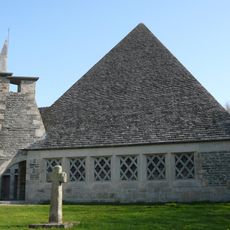
Calvary at Plougastel-Daoulas, Religious monument in Plougastel-Daoulas, France.
The Calvary at Plougastel-Daoulas is a grey stone monument about 10 metres high. Its octagonal core of yellow Logonna microdiorite is flanked by four arched buttresses, and a stair of 14 steps near the north-west buttress leads to the platform where preachers once stood. The 182 figures, carved in blue Kersanton stone, include a central crucifixion group with the two thieves and a reclining figure below.
The monument was built between 1602 and 1604 to mark the end of the 1598 plague epidemic. It suffered considerable damage during World War II bombings in 1944.
The monument displays 28 scenes depicting biblical stories, with each side oriented to a cardinal direction. The stonework reflects local traditions and artistic preferences of the time.
The Calvary stands in the centre of Plougastel-Daoulas, just south of the rebuilt Saint-Pierre church. A stairway of 14 steps by the north-west buttress leads to the platform where preachers once stood. Visitors walk around the base to read the scenes, which run anticlockwise starting from the Annunciation.
Four evangelists appear on the buttresses wearing 17th-century Breton clothing instead of traditional biblical garments. This unusual choice shows how local artists integrated their own culture into a religious work.
The community of curious travelers
AroundUs brings together thousands of curated places, local tips, and hidden gems, enriched daily by 94,608 contributors worldwide.