Chapelle Sainte-Avoye, Renaissance chapel in Pluneret, France.
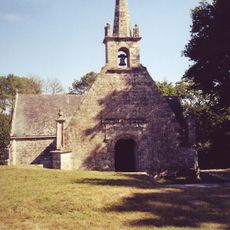
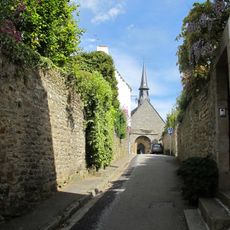
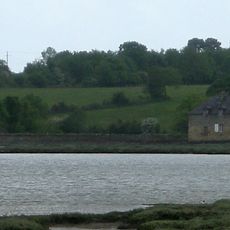
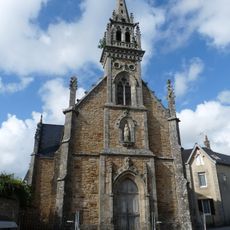
Chapelle Sainte-Avoye is a 16th-century seigneurial chapel in the village of Sainte-Avoye, Pluneret, set on the right bank of the Bono river. Its light stone facade has a large round-arched window with a diamond-patterned metal lattice above two red plank doors, with a carved stone corbel between them. Inside, the nave vault is shaped like an inverted ship's hull and whitened in the old way, and a polychrome oak rood screen carved between 1554 and 1557 separates the nave from the choir.
The first stone was laid on 14 September 1554, and the first timber on 10 June 1557, for a seigneurial chapel built by the Lestrelin family, owners of the nearby château de Kerisper. Its original bell tower, taller than today's, served as a landmark for sailors and a lookout over the rivière du Bono. Struck by lightning in 1727, the upper part was replaced by the present timber roof topped with a spire; a 1987 storm weakened the tower again, and it was repaired in 1988.
The south door bears the Lestrelin family coat of arms, and the seigneurial seat inside once showed four ducks, cut away with a knife during the Revolution. The oak rood screen, carved between 1554 and 1557, shows the Twelve Apostles on the nave side and the seven virtues with five saints, including Saint Yves, on the choir side.
Visiting is best during regular opening hours when the chapel is accessible and interiors can be viewed. A walk through the surrounding area helps you understand its setting within the local landscape.
The oak rood screen, carved between 1554 and 1557 by a carpenter named Bizeul, shows the Twelve Apostles on the nave side and the seven virtues with five saints, including Saint Yves, on the choir side. It has been listed as a monument historique in its own right since 27 December 1907.
The community of curious travelers
AroundUs brings together thousands of curated places, local tips, and hidden gems, enriched daily by 93,625 contributors worldwide.