Chapelle Sainte-Thérèse-de-l'Enfant-Jésus et de la Sainte-Face, Religious chapel in Hem, France.
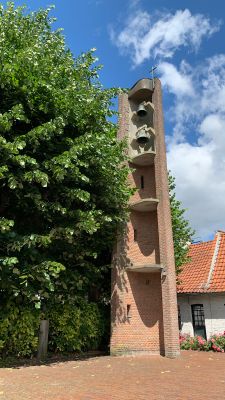
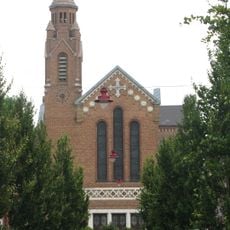
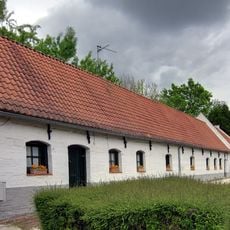
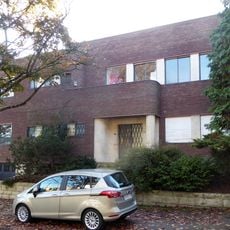
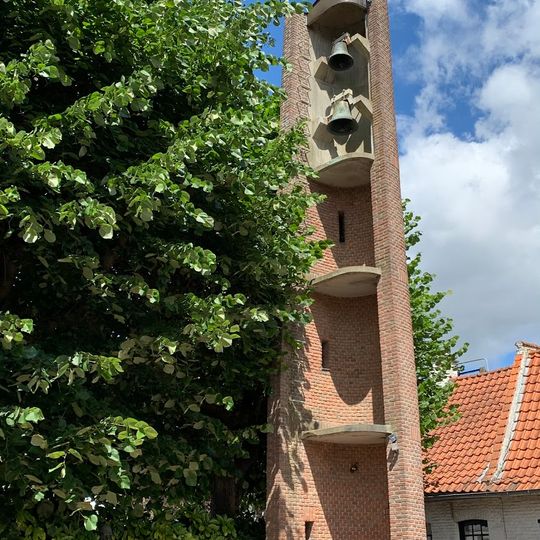
The Chapelle Sainte-Thérèse-de-l'Enfant-Jésus et de la Sainte-Face is a chapel in Hem built from 1956 to 1958 to designs by Swiss architect Hermann Baur, set within a former Flemish farm courtyard. Its barn-like form is preceded by a campanile set back from the parvis, topped by a canopy decorated with a mosaic. Two walls of stained glass by Alfred Manessier, an altar by Eugène Dodeigne and a tapestry after Georges Rouault are inside.
The textile industrialist Philippe Leclercq funded construction of this chapel between 1956 and 1958 near his residence in the Hempenpont district. The project arose during the post-war period when new religious spaces were being built for growing working-class communities.
Two walls of stained glass by Alfred Manessier depict the life of Saint Thérèse of Lisieux. The west wall, called the tree of life, stylises the plane trees pruned as espaliers outside the chapel. Manessier assigned each colour a meaning: red for suffering, violet for spirituality, yellow and white for light, blue for life.
Visitors should note that the stained glass walls allow daylight to flood the interior, so the experience varies greatly depending on the time of day. It is best to visit during daylight hours to fully appreciate the artistic design.
The chapel's altar, made by sculptor Eugène Dodeigne, can be used both for the traditional rite with the priest's back to the congregation and for the post-Vatican II rite facing the assembly, although the building was completed in 1958, before the council. The designers planned for the liturgical change in advance.
The community of curious travelers
AroundUs brings together thousands of curated places, local tips, and hidden gems, enriched daily by 94,657 contributors worldwide.