Camp de Beugy, Medieval military camp in Sainte-Suzanne-et-Chammes, France.
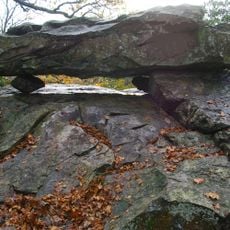
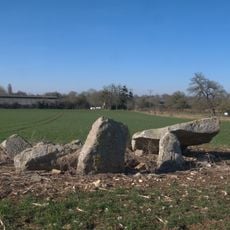
Camp de Beugy covers about 2.5 hectares on a hillside 800 m north of Sainte-Suzanne. Two rectangular earth-and-stone enclosures, a western one of 95 by 85 m and a larger eastern one of about 110 by 100 m, are separated by a ditch cut through a rocky bar. The ramparts, now eroded by two to three metres, form a horseshoe layout; the south side faces the fortress, visible but beyond the range of period weapons.
Orderic Vital, whose father had fought at William's side in England, records that the king, unable to take Sainte-Suzanne, raised a fort in the Beugic valley and garrisoned it to contain the enemy. The siege failed, and Hubert II de Beaumont kept the fortress. The earthworks were listed as a monument historique on 28 July 1937.
The camp is also called the English camp, a name tied to William the Conqueror's troops. The neighbouring plots are named La Motte and Châteauneuf, though these place names date from the modern era. The site has been listed as a monument historique since 28 July 1937 and received the ICOMOS label "Architecture de terre remarquable en Europe" on 4 May 2011.
The camp lies about 800 m north of Sainte-Suzanne, between the D143 toward Assé-le-Bérenger and the C201 lane, above meadows by the Erve. The western enclosure is cut on its south side over more than 40 m, where farm buildings stood until 1981. Approach on foot from the surrounding lanes to read the earthworks.
The earthen walls were reinforced with stones quarried directly from the ditch excavations during construction. This practical approach made full use of materials found on site during the building process.
The community of curious travelers
AroundUs brings together thousands of curated places, local tips, and hidden gems, enriched daily by 93,665 contributors worldwide.