Donjon de Barjac, Medieval castle in Barjac, France.
Donjon de Barjac is a castle in southern France composed of three distinct sections: a cubic central block, a southwestern wing, and a medieval tower positioned at the southeast corner. The building contains a public library, cinema spaces, and reception areas that have been adapted from the castle's original functional rooms.
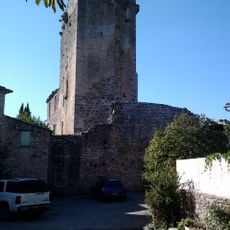
The site comprises three buildings of different periods around an inner courtyard. The seigneurial tower was built on a rock at the lieu-dit "Bargacum" in the second half of the 10th century; its upper section, carrying the bellcote for the communal bell, dates from 1649. The Château vieux or "Castel Viel", later used as Barjac's prisons, was built in the 12th century as a three-level keep. A new Logis was added between 1634 and 1639 by Jacques de Grimoard de Beauvoir du Roure and his son, with stables and a vaulted gallery built in 1645-1652.
The castle owes its name to the Beauvoir du Roure family, its owners until the French Revolution. Since 2008 the restored building has housed the town hall and exhibition, drawing, painting, dance and music rooms. In summer the courtyard hosts the song festival Barjac M'en Chante.
The town hall occupies the restored 17th-century logis, inaugurated in 2008; the former stables, kitchens and galleries now hold the library, cinema and function hall. The old keep was restored only on the outside and is not open inside. In summer the inner courtyard hosts the song festival Barjac M'en Chante.
The bell still hanging in the tower was placed there in 1649, when the upper section supporting the bell tower was built to house the communal bell. The tower itself, built on a rock at the spot called "Bargacum", dates from the second half of the 10th century, making it the oldest of the three castles.
The community of curious travelers
AroundUs brings together thousands of curated places, local tips, and hidden gems, enriched daily by 94,547 contributors worldwide.