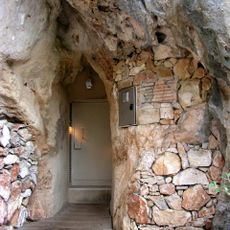
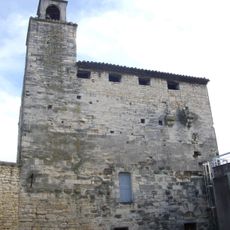
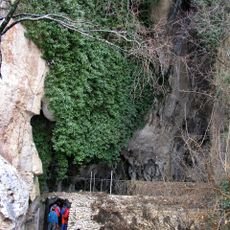
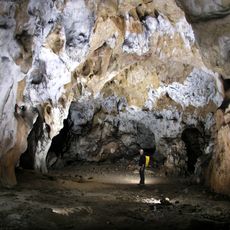
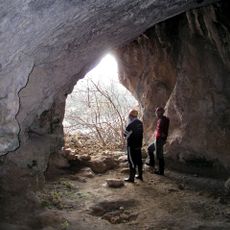
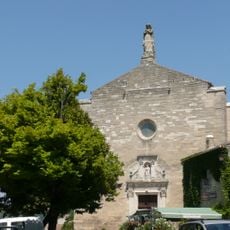
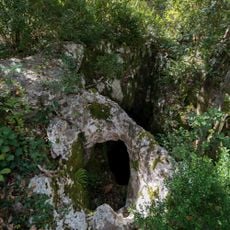
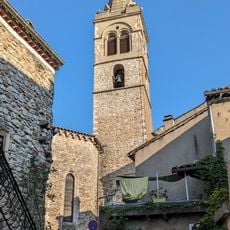
Goule de Foussoubie, Cave entrance in Labastide-de-Virac, France.
The Goule de Foussoubie is the main entrance of a karst network on the communes of Vagnas, Labastide-de-Virac and Salavas in the Ardèche, 1.5 km north-west of Labastide-de-Virac. Its galleries run more than 23 km with a drop of 138 m. The opening is a tall oval in weathered grey stone, moss on the rock beside it; inside, the floor slopes down as a bank of pale brown dirt and stones to a wet channel.
Exploration of the network began in the 18th century and drew many cavers, among them Jules de Malbos. From 3 to 7 June 1963 a storm flood caused the disappearance of speleologists Jean Dupont and Bernard Raffy, members of the Lyon group Vulcain; a chasm at Samoëns in Haute-Savoie was named gouffre Jean-Bernard in their memory. Photographs taken on 17 November 2006 record the force of its floods.
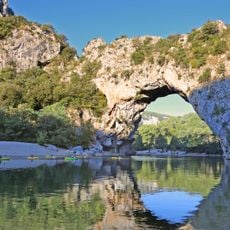
The name "goule" comes from the Occitan "gola", meaning mouth or throat, and the site is written "Gola de Fossobia" in Occitan. The entrance absorbs runoff from a depression of about 5 km² across Vagnas, Labastide-de-Virac and Salavas, and the water resurges in the Ardèche 800 m upstream of the Pont d'Arc, 3.4 km from the entrance as the crow flies.
The entrance lies 1.5 km north-west of Labastide-de-Virac, and the water resurges 3.4 km away, 800 m upstream of the Pont d'Arc. Storm floods are dangerous, as photographs taken on 17 November 2006 show. Caving here requires training and equipment.
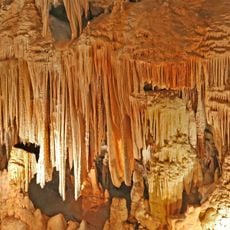
The cave system is home to specialized animals found only in this karst environment, including colorless crustaceans and endemic amphipods. These rare life forms show how caves form completely isolated ecosystems with their own distinct wildlife.
The community of curious travelers
AroundUs brings together thousands of curated places, local tips, and hidden gems, enriched daily by 94,288 contributors worldwide.