Couvent des Cordeliers de Reims, Ruined Franciscan convent in Reims, France
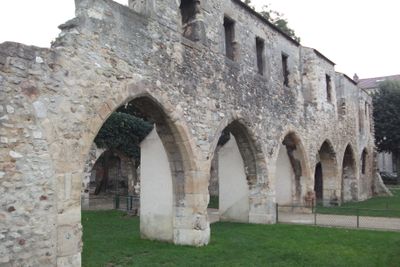
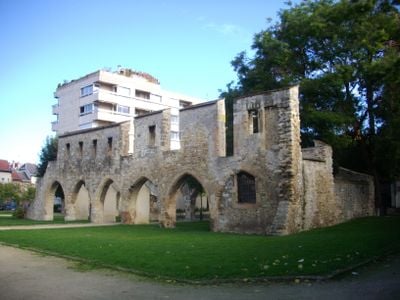
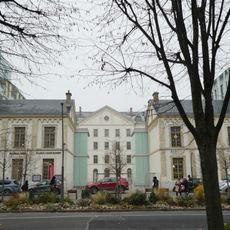
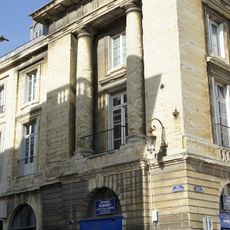
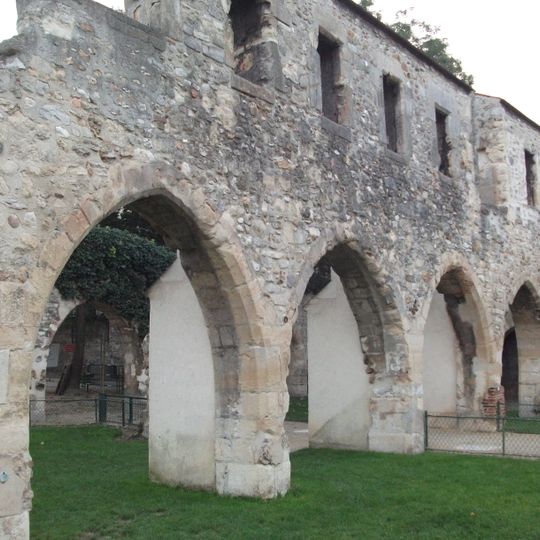
The Couvent des Cordeliers de Reims is a ruined Franciscan convent at the corner of rue Voltaire, rue des Trois-Raisinets and rue de l'Isle, facing the école Voltaire. Its rough grey, tan and brown masonry survives as a row of tall pointed arches on thick piers, with narrow rectangular window openings above and no roof; the arches are filled below with pale plastered surfaces, and grass runs along the base.
The Franciscans settled in Reims in the 13th century, first beside Guillaume de Joinville's town castle, destroyed in a revolt. Henri de Braine then allowed them to move to the city centre, where their conventual hall hosted city council meetings before Reims had a town hall. A fire destroyed the abbey in 1450; it was rebuilt and embellished. In 1791 its 850 books went to the municipal library, the buildings were sold as national property and turned into a spinning mill, and the church was demolished in 1813.
The name survives in the street name and in local memory: the Cordeliers were the Franciscan friars whose conventual hall hosted meetings of Reims' city council and of merchant congregations before the town hall was built. Today the former convent is a public square with a children's playground, facing the Voltaire school.
The remains stand at the corner of Rue Voltaire, Rue des Trois-Raisinets and Rue de l'Isle, facing the École Voltaire. Since the end of the First World War the former convent grounds have been laid out as a public square with a children's play area, so the arches can be viewed at any time from the open lawn.
The convent church was demolished in 1813, but the surviving walls were sold as national property and turned into a spinning mill, which kept the name Les Cordeliers. Artists recorded the ruins during the First World War, among them Gaston Laplace in 1915 and Marie Perrier in 1919.
The community of curious travelers
AroundUs brings together thousands of curated places, local tips, and hidden gems, enriched daily by 93,107 contributors worldwide.