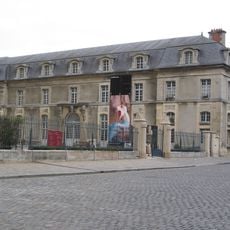
Porte Bazée, Roman gate in Reims, France.
Porte Bazée is a Roman monument of Reims whose surviving pier is set into the corner of a light-coloured building on Rue de l'Université, at the refectory of the Collège Université. The vertical stone assembly has a plain rectangular base, a narrow carved panel with overlapping reliefs of a round shield-like form, a helmet, crossed items and tangled rope or serpent shapes, a dark metal plaque above, and a foliate carved band at the top. A small square ventilation grille sits below it near the ground.
The gate was built between 180 and 230 CE and originally reached about 13 meters in height. It served as the southern entrance to the Roman city and was a key part of the defensive walls protecting Durocortorum.
The name comes from 'porta Basilicaris', referring to its role as a passage toward the churches located in the city's outlying areas. For centuries, residents used this gateway as a key connection between the urban center and the religious sites beyond the walls.
The surviving pillar fragment stands inside the Collège Université, at the level of its refectory on Rue de l'Université. The monument is set flush into the building wall, with a small ventilation grille below it near the ground, so look at the corner of the facade rather than expecting a free-standing arch.
The relief cited by Dom Marlot showed a triton with Cupid and Venus seated on it. The arch also marked the start of the Via Caesarea, the road leading to Rome, so travellers left the city through this gate.
The community of curious travelers
AroundUs brings together thousands of curated places, local tips, and hidden gems, enriched daily by 93,428 contributors worldwide.