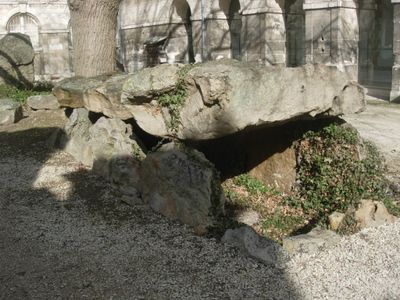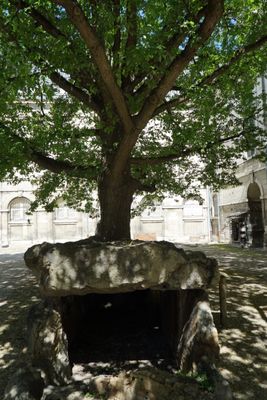
Allée couverte des Grèves de Frécul, Neolithic dolmen in Barbuise, France.
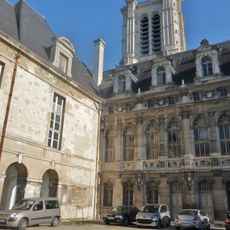
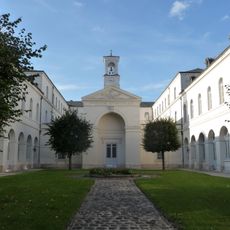
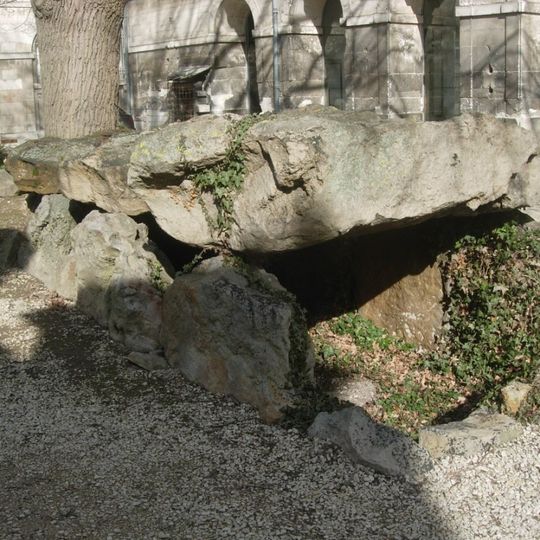
The Allée couverte des Grèves de Frécul is a Neolithic gallery grave with a chamber 4.40 m long, 1.55 m wide and 1.25 m high, built from seven upright stones, three capstones and four smaller slabs at the entrance. It now stands in the courtyard of the Musée Saint-Loup in Troyes, where the large flat capstone rests on upright supports above a dark recessed opening.
The Allée couverte des Grèves de Frécul was excavated in situ in 1864; it lay 100 m north of the Dolmen des Grèves de Frécul, in the Charnier wood on the Barbuise side. Oriented north-south, it linked a burial chamber to the largest of the Frécul dolmens. In 1874 it was moved into the courtyard of the Musée Saint-Loup in Troyes to save it from quarrymen; it was inscribed as a monument historique in 1993.
The monument's name comes from the Grèves de Frécul, the alluvial plain of the Seine where it stood, in the Charnier wood on the Barbuise side; the farm of Frécul itself lies in La Saulsotte. It was one of at least four monuments recorded at Barbuise and twelve at La Saulsotte, alongside Passy-type structures and Bronze Age enclosures. Two vases, one in pot-de-fleur style, are known only from drawings and have since disappeared.
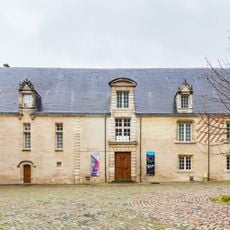
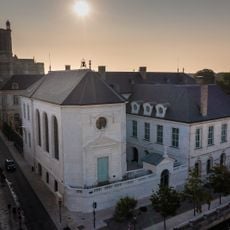
The monument stands in the courtyard of the Musée Saint-Loup in Troyes, not indoors, so it is exposed to the weather. It was moved there in 1874 to save it from quarrying. Look for it among the museum's lapidary collections; the original site lies in the Charnier wood at Barbuise, near the Dolmen des Grèves de Frécul.
Flint tools and a black stone axe were discovered inside during the 1864 excavation, offering clues about what people valued enough to place with their dead. These items reveal practical objects used in daily life thousands of years ago.
The community of curious travelers
AroundUs brings together thousands of curated places, local tips, and hidden gems, enriched daily by 94,462 contributors worldwide.