Domaine national de Marly-le-Roi, Royal estate and gardens in Marly-le-Roi, France
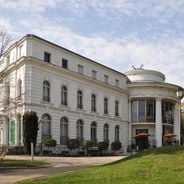
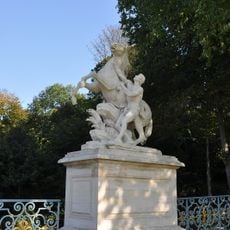
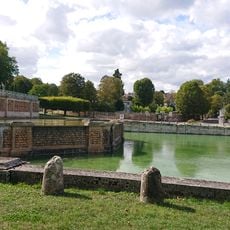
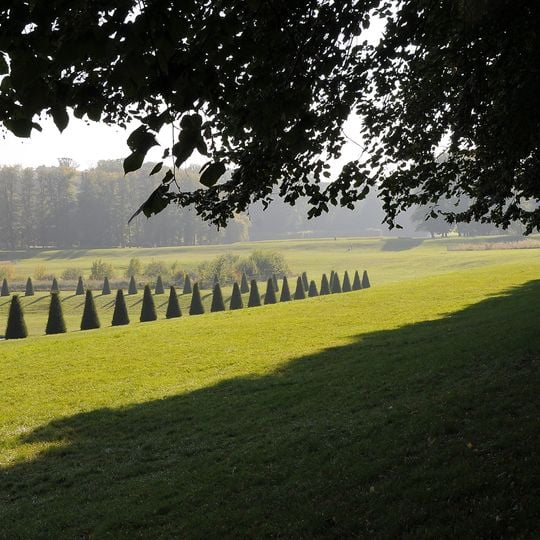
The Domaine national de Marly-le-Roi is a sloping park on the south bank of the Seine, laid out for Louis XIV's château built by Jules Hardouin-Mansart and destroyed under the First Empire. Only the ground plan of the château survives, along with the great alignments of the former gardens and the abreuvoir downstream, whose two basins are topped by copies of the Chevaux de Marly. A row of small cone-shaped evergreens crosses the mown lawns of the slope.
Louis XIV had Jules Hardouin-Mansart build the château as a retreat from court life at Versailles. It was destroyed in the early 19th century under the First Empire, not during the Revolution. The abreuvoir was listed as a monument historique in 1862, and the whole domain only in 2009.
The park keeps the ground plan of Jules Hardouin-Mansart's château, destroyed in the early 19th century under the First Empire, and the great alignments of Louis XIV's day. The abreuvoir, the watering trough downstream with its two basins, is crowned by copies of the Chevaux de Marly; most original garden sculptures are now in the Cour Marly of the Louvre. The museum displays the domain at its height under Louis XIV and its fate under Louis XV and Louis XVI, evoking figures such as Madame du Barry and artists François Boucher, Élisabeth Vigée-Lebrun and Claude-Nicolas Ledoux.
The park lies on a south-facing slope above the Seine, its lower end opening onto the centre of Marly-le-Roi and its west side adjoining the Marly state forest. The royal gate and the old château doors, such as the porte d'honneur and the porte du Phare, control access to the domain. The ground plan of the château is marked on the lawn, and the abreuvoir with its two basins and copies of the Chevaux de Marly stands downstream.
The original garden sculptures are now mostly kept in Paris, in the Cour Marly of the Louvre; the figures at the abreuvoir are copies. The machine that pumped water to Marly and Versailles stood in neighbouring Bougival, not on the domain. The park has also served as a film set, for Jean Delannoy's La Princesse de Clèves (1961) and for two 2018 films.
The community of curious travelers
AroundUs brings together thousands of curated places, local tips, and hidden gems, enriched daily by 92,825 contributors worldwide.