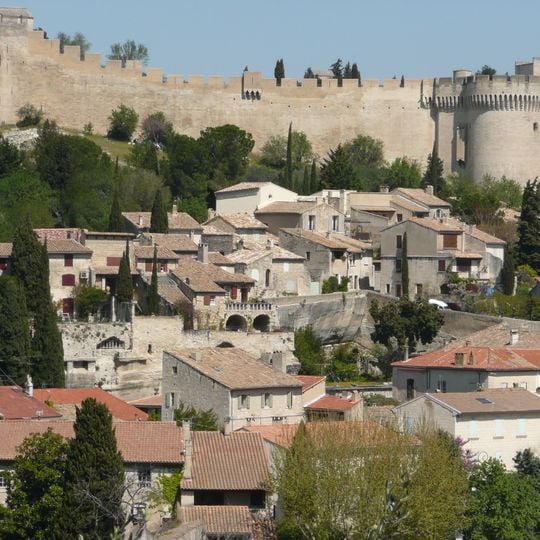
Fort Saint-André, Medieval fortress on Mount Andaon, Villeneuve-lès-Avignon, France.
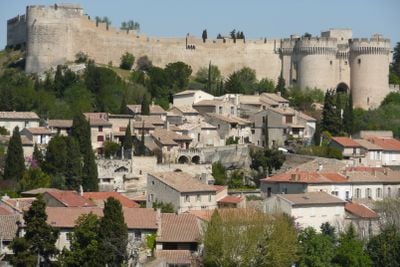
Fort Saint-André is a medieval fortress on Mount Andaon in Villeneuve-lès-Avignon, with a 750-metre curtain wall enclosing the Benedictine abbey and the village of Saint-André. Its entrance is flanked by twin towers with a machicolated crown, and the wall is punctuated by the Tour des Masques. A 12th-century chapel, Belvézet, stands inside.
The paréage treaty of 1292 between Philip the Fair and the Benedictine abbey of Saint-André let the king build a fortress with a permanent garrison beside the abbey on Mount Andaon. The abbey gave up temporal power in exchange for protection from Avignon. The curtain wall and towers were raised in stages during the first half of the 14th century, and Jean de Louvres, architect of the Palais des Papes, completed the work under Charles V.
The site is named after Saint Andrew and served in the Middle Ages as a symbol of French power overlooking the papal territory. Visitors can still see the chapel and defensive passages that reveal how the garrison organized daily life within these walls.
The entrance is through the twin-towered châtelet, where two portcullises once closed the passage and the room above held the winches that raised them. The 750-metre curtain wall encloses the abbey and the Belvézet chapel, and the walk between them follows ground that rises 24 m from south to north.
The twin entrance towers, called the "royal castle", held the rooms of the châtelain and the viguier; the entrance was closed by two portcullises worked from the hall above, and the viguier's room keeps the royal arms on a keystone. Higher up, the Tour des Masques, named from the Occitan mascas for witches, is a single tall room covered in graffiti left by soldiers and prisoners.
The community of curious travelers
AroundUs brings together thousands of curated places, local tips, and hidden gems, enriched daily by 92,785 contributors worldwide.