Forêt de Quénécan, Forest area in Morbihan and Côtes-d'Armor, France.
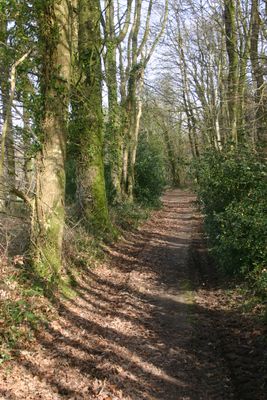
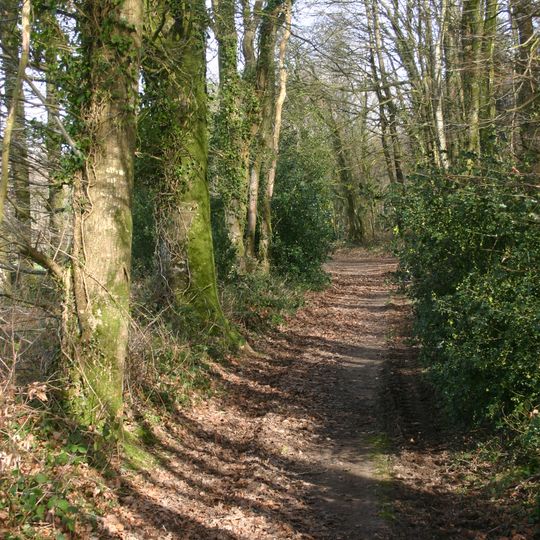
The Forêt de Quénécan is a 3,700-hectare woodland of oaks, beeches, chestnuts and hollies, with maritime and Scots pines, Sitka spruce, Douglas fir and yew, straddling the Morbihan and Côtes-d'Armor border. A dirt path covered with dry brown leaves runs through it, past a thick trunk with grayish-green bark and ivy at its base, between dense dark green bushes and thin bare trees. It shelters nearly 70 breeding bird species in winter.
The forest is named in a description by François-Marie Cayot Délandre in 1847, who noted that it covered about half of Sainte-Brigitte and extended over Perret, Lescouët, Caurel, Saint-Aignan, Cléguérec, Séglien and Silfiac. In 2007 the forest, the Poulancre valley, the Liscuis moors and the Daoulas gorges were designated a Natura 2000 special conservation area, in five separate units totalling 922 hectares.
The forest is nicknamed "little Breton Switzerland". Its name may come from Breton kenec'h, "height", and gwen, "white", referring to rock faces that shine in the sun. In 1847 François-Marie Cayot-Délandre recorded a local tale that the rocks of the Breil du Chêne were dropped there by the devil's grandmother, carried in her apron.
The woodland has marked trails that allow visitors to navigate and explore different parts of the forest. Spring through fall offers the most accessible conditions for walking and better visibility throughout the day.
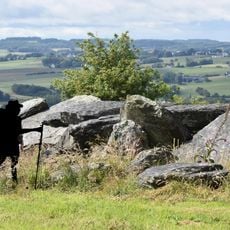
The forest's highest point is the Breuil du Chêne, south of the woods at 289 metres, marked by a calvary. In 1847 François-Marie Cayot-Délandre described this spot as crowned with huge stacked blocks of grauwacke, and recorded a legend that the devil's grandmother carried the rocks there in her apron.
The community of curious travelers
AroundUs brings together thousands of curated places, local tips, and hidden gems, enriched daily by 92,776 contributors worldwide.