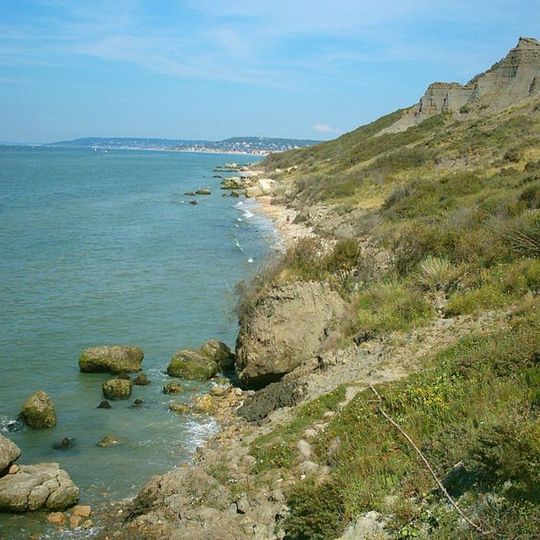
Falaises des Vaches Noires, Protected coastal area in Normandy, France.
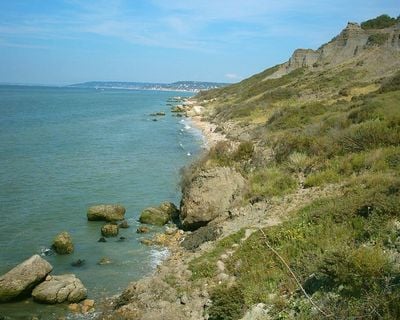
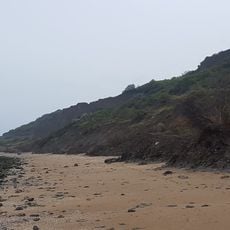
Falaises des Vaches Noires is a 4.5 km stretch of clay cliffs up to 100 m high, topped by a thin chalk layer, on the Normandy coast between Houlgate and Villers-sur-Mer. Deep ravines cut the Oxfordian marls, and slow mudflows carry Cretaceous chalk blocks down to a rocky foreshore where dark seaweed-covered boulders lie.
The first dinosaur remains found in France were discovered at this location by Abbot Charles Bacheley and later examined by Georges Cuvier. These early discoveries established this site as important to paleontology.
The name comes from chalk blocks that fell onto the foreshore and turned black with attached seaweed; from the cliff top or offshore they looked like a herd of black cows. In the 19th century Trouville fishermen used these rocks as navigation markers, naming them in contrast to the Roches Noires below the Trouville cliffs.
The cliffs themselves are closed to the public by prefectoral decree; they can only be observed from a path along their foot, passable at low tide alone. Fossil collecting is tolerated on the foreshore at the base of the cliffs. A 2022 plan for a national nature reserve of the Jurassic cliffs of Calvados would also ban collecting on the foreshore, subject to exemptions.
Abbot Charles Bacheley (1716–1795) collected the first dinosaur bones found in France at these cliffs; Georges Cuvier later described them. They are among the oldest dinosaur remains complete enough to serve as the type of a valid name. The site also yielded Leedsichthys, a plankton-feeding fish about twenty metres long.
The community of curious travelers
AroundUs brings together thousands of curated places, local tips, and hidden gems, enriched daily by 93,249 contributors worldwide.