Grange Huguenet, Protected historic barn in Besançon, France
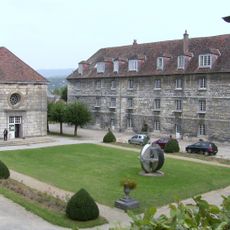
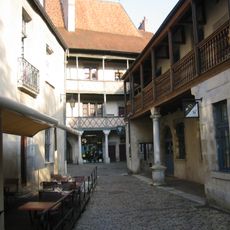
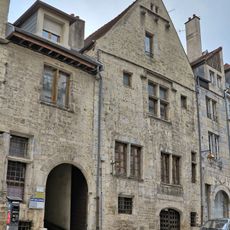
Grange Huguenet is a former agricultural barn in the Montrapon-Fontaine-Écu district of Besançon, now a country residence. Its pale stone buildings centre on an arched gateway with a slatted wooden roof and a closed wrought-iron gate; a low wing with a reddish-brown tiled roof stands left, a taller section with barred windows right. A plastered pale yellow-beige building with brown shutters and climbing foliage faces a gravel path.
Grange Huguenet is an 18th-century building in Besançon that belonged to Emmanuel Rochet, a city alderman (échevin). After his death it passed to his widow Jeannette Martin, then to his nephews Claude Joseph Huguenet, a lawyer and the King's prosecutor, and Joseph Xavier Huguenet, a doctor. In 1790 the wine merchant Jean François Munier bought the estate, and in 1848 Alphonse Delacroix, married to Jenny Munier, moved in and gave the building its present appearance.
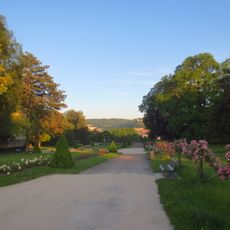
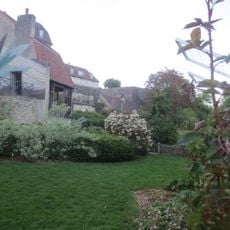
The name comes from the Huguenet nephews who inherited it in the 18th century: Claude Joseph, a lawyer and the King's prosecutor, and Joseph Xavier, a physician. Alphonse Delacroix, who moved in in 1848, kept the old yew and hornbeam clumps and the walnut avenue, and planted paulownias, catalpas, sequoias and sophoras as he had on the Promenade Micaud. The park, with its meal corners, tables, benches and skittle games, has been listed since 1937.
The 4.5-hectare park sits on elevated ground with a view over Besançon and its surroundings; the entrance is through the arched gateway with its wrought-iron gate on the Montrapon-Fontaine-Écu side. The park has been a protected natural site since 1937, so paths and old tree groups are kept as they are. The whole property is a listed monument, and visits concern the building, the park, the enclosing wall and the gates.
The 4.5-hectare park was listed among sites of artistic, historical, scientific, legendary and picturesque character in 1937, at the request of archaeologist and co-owner Robert Demangel, to protect it from urban development. Alphonse Delacroix kept the old yew and hornbeam clumps and the walnut avenue, but replaced the fruit trees with paulownias, catalpas, sequoias and sophoras, the same species he used for the Promenade Micaud.
The community of curious travelers
AroundUs brings together thousands of curated places, local tips, and hidden gems, enriched daily by 94,074 contributors worldwide.