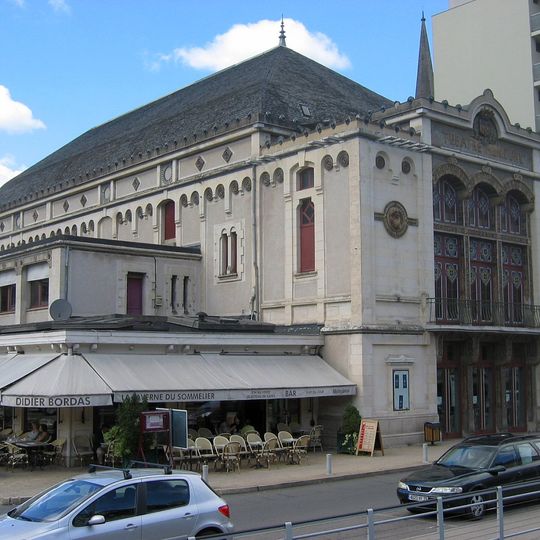
Théâtre des Sept Collines, Municipal theater in Tulle, France.
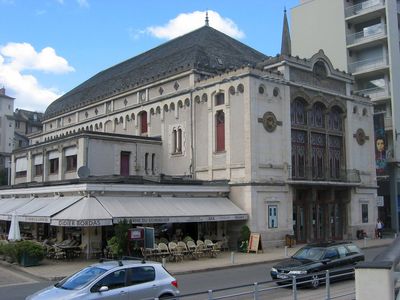
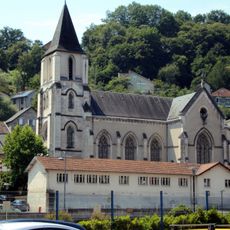
The Théâtre des Sept Collines has a pale stone facade with a steep dark grey slate roof topped by a thin spire. Tall rectangular windows with pinkish-red panels sit between pilasters, and a lower section carries a long white awning reading "LA TAVERNE DU SOMMELIER" and "DIDIER BORDAS". Its interior is a single-tier Italian-style auditorium with an 11-by-8-metre stage opening and a 13-metre-deep stage.
The building was constructed between 1899 and 1902 under architect Anatole de Baudot's direction and received historical monument status in 1977. It pioneered the use of reinforced concrete as a construction material.
The theatre is named after Tulle's seven hills and has been part of the Scène nationale L'Empreinte since 2017, when it merged with Brive-la-Gaillarde's Théâtre des 13 arches; the joint structure took the name L'Empreinte in 2018. Its stage opening, enlarged to 11 by 8 metres with 13 metres of depth, allows almost any type of show.
The theatre stands on the Quai de la République on the bank of the Corrèze. Its stage opening measures 11 by 8 metres with a depth of 13 metres, so it can host almost any type of show. The 1994 renovation was funded 50% by the state and 30% by the region.
The reinforced-cement method was devised by engineer Paul Cottancin, and Anatole de Baudot, a follower of Viollet-le-Duc's rationalist school, chose it here to remove the fire risk that plagued theatres. The 1932 cinema conversion hid the original cement roof beneath the slate roof visible today.
The community of curious travelers
AroundUs brings together thousands of curated places, local tips, and hidden gems, enriched daily by 92,898 contributors worldwide.