Saint-Tropez lighthouse, Maritime navigation beacon in Saint-Tropez harbor, France
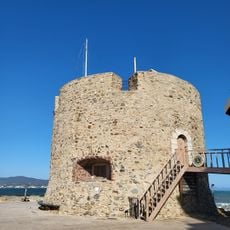
The Saint-Tropez lighthouse stands at the end of the jetty in the old port: a cylindrical shaft of rough light grey-beige stone blocks rising from a broader stone and concrete base. A single small rectangular window sits below the red metal lantern room, whose domed roof and gallery railing are also red. A low stone wall and a long curved bench run along the rocky outcrop at its foot.
The first lighthouse, a 15-metre cylindrical masonry tower with a fixed red light, was built in 1866 at the end of the great jetty and called the "red lighthouse". It was electrified in 1932, destroyed by German troops in 1944, and replaced from 1952 to 1968 by a reinforced concrete turret. After the jetty was extended in 1967, an 8-metre wooden pylon served as a provisional light for 32 years. The town rebuilt a copy of the 1866 tower in 1999, inaugurated on 1 January 2001.
The lighthouse is known as the "red lighthouse" (phare rouge) after the colour of its fixed red light. In the late 19th and early 20th centuries it drew post-Impressionist painters such as Paul Signac, who visited Saint-Tropez and depicted the tower in their works. The town rebuilt it in 1999 as a replica of the 1866 original.
The lighthouse stands at the tip of the north jetty of the old port, reached on foot along the pier. The rocky outcrop at its base has a low stone wall and a long curved bench, a spot to sit facing the water. The lantern room is not open to visitors.
The structure emits a specific light pattern at night that helps ships safely identify the harbor entrance. This recognition system plays an important role in Mediterranean navigation.
The community of curious travelers
AroundUs brings together thousands of curated places, local tips, and hidden gems, enriched daily by 94,410 contributors worldwide.