Pasteur bridge, Concrete bridge across the Rhône River in Lyon, France
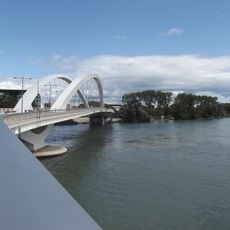
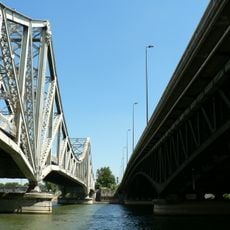
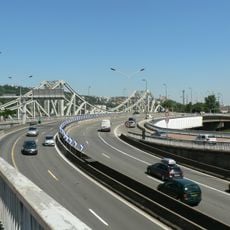
Pasteur Bridge spans the Rhône in Lyon, linking the quai Perrache on the right bank to the place Antonin-Perrin on the left bank. The current 1952 structure by engineer Mogaray has three arches, each made of three reinforced-concrete ribs with spans of 64, 70 and 64 metres, and is extended on both banks by false abutments. It is over 18 metres wide, with pavements of 3.32 metres.
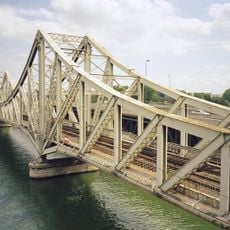
A first temporary footbridge, the passerelle de l'Exposition, was built for the 1914 universal exhibition at Gerland and later renamed pont des Abattoirs; a flood swept it away in October 1918. A three-arch metal bridge named pont Pasteur replaced it in 1923, 225 m long. German forces destroyed it on 2 September 1944, and engineer Mogaray built the present bridge from 1949, inaugurated in 1952.
The bridge received its name from Louis Pasteur, the French scientist who made significant contributions to microbiology and developed the first vaccines.
Pasteur Bridge links the quai Perrache on the right bank with the place Antonin-Perrin on the left bank. Its sidewalks are 3.32 metres wide beside an 11-metre roadway, and the deck is more than 18 metres across. The span is 225 metres long, carried on three arches of 64, 70 and 64 metres, with false abutments continuing onto both banks.
The 1923 bridge had unusually wide pavements of 5.25 metres for an 11-metre roadway; the present structure, built from 1949 by engineer Mogaray and opened in 1952, cut them to 3.32 metres while widening the deck to over 18 metres. Its three spans of 64, 70 and 64 metres each contain three reinforced-concrete arches.
The community of curious travelers
AroundUs brings together thousands of curated places, local tips, and hidden gems, enriched daily by 92,863 contributors worldwide.