Pont de Beaugency, Medieval stone bridge in Beaugency, France
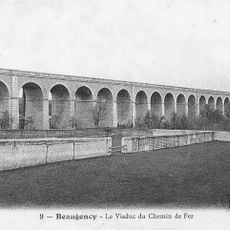
Pont de Beaugency is a stone arch bridge crossing the Loire River near Beaugency with approximately twenty arches and a main span of around 15 m (49 ft). The structure extends for about 460 m in length, connecting both riverbanks with its characteristic multi-arch design.
The bridge is cited in a 1145 act of Simon II de Beaugency, and archival documents place the origin of the current structure in the 14th century, when its oldest pointed arches were built. In 1505 a flood destroyed the Île du Pont and its wooden drawbridge, after which two arches were rebuilt. A flood in 1608 swept away the left-bank faubourg and left only 14 of the 14th-century arches standing; the wooden spans then built were destroyed by ice in 1677 and replaced in masonry, and in 1710 another flood toppled all but two of those vaults.
The bridge's name comes from the town of Beaugency on the right bank. Until the 19th century, a chapel dedicated to Saint James stood on the structure, and a wooden drawbridge at the island of Pont protected the town. Today the bridge carries the D925 road and is part of the Loire Valley UNESCO World Heritage site.
The bridge carries the D925 between Beaugency on the right bank and Lailly-en-Val on the left. The roadway is 6 m wide, flanked by two pavements from 1 m to 3 m wide, so walkers cross beside traffic. The deck is flat and low over the water.
The bridge was cited in 1145 in an act of Simon II de Beaugency, and a chapel dedicated to Saint James stood on it, according to the 17th-century account of its medieval state. Two separate bridges once met at a wooden drawbridge over the Île du Pont, a defence for the town until the 1505 flood destroyed the island and the drawbridge.
The community of curious travelers
AroundUs brings together thousands of curated places, local tips, and hidden gems, enriched daily by 94,474 contributors worldwide.