Château de Beaugency, Medieval fortress in Beaugency, France.
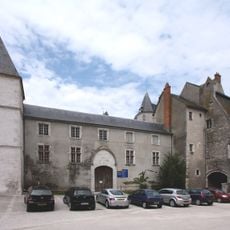
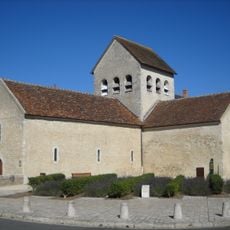
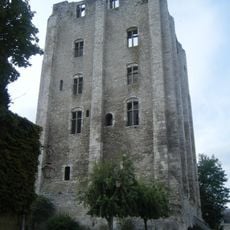
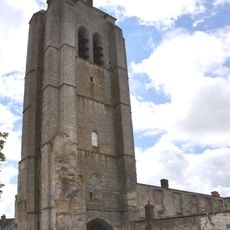
Château de Beaugency is a medieval castle whose square keep, 36 m high with 20 m sides, rises behind a long white building with a steep grey roof, three dormers and a round tower with a conical roof. The keep's walls are 3.8 m thick at the base and 1.8 m at the top, built of stone blocks up to 1 x 1.3 m taken from Roman monuments nearby. A narrow tower with a pointed spire stands to its right.
The square keep, 36 m high with 20 m sides, was built in the early 12th century on foundations of Roman stone blocks measuring 1 x 1.3 m. Philip the Fair bought the fortress in 1291, and Charles V gave it to his son Louis of Orléans. The English besieged it five times during the Hundred Years' War before taking it, and Joan of Arc retook it in 1429. Charles of Orléans then gave it to his half-brother Dunois, who built a more comfortable residence around the keep.
The castle takes its other name, château Dunois, from Jean de Dunois (1402–1468), the companion of Joan of Arc who received it from Charles of Orléans and built a more comfortable residence around the keep. It housed the Orléans Museum of Art and Folklore until 2002 and is now a private residence reopened to visitors in October 2014.
The castle is open most days of the week, though some days are closed to visitors. Plan to spend several hours exploring the different rooms, towers, and the courtyard at a leisurely pace.
The keep's stone blocks measure about 1 by 1.3 metres and were taken from nearby Roman monuments, so the tower's lower walls reuse ancient masonry. The square keep rises 36 metres, with walls 3.8 metres thick at the base and 1.8 metres at the top.
The community of curious travelers
AroundUs brings together thousands of curated places, local tips, and hidden gems, enriched daily by 93,263 contributors worldwide.