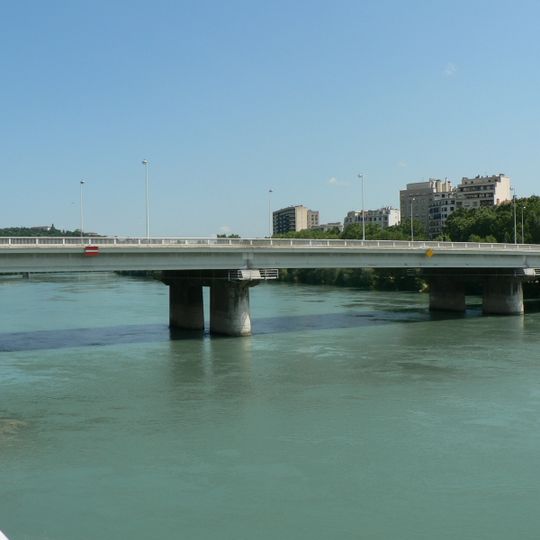
Lattre de Tassigny bridge, Steel bridge across Rhône River in Lyon, France
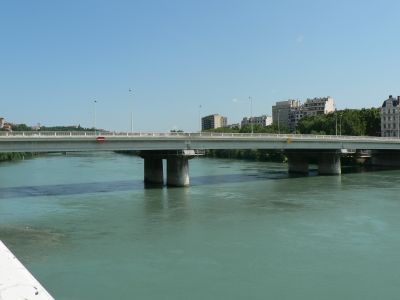
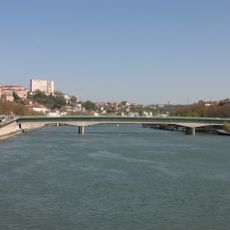
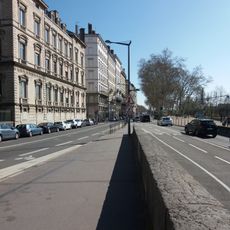
The Lattre de Tassigny Bridge is a concrete bridge over the Rhône in Lyon, 150 m long and 25 m wide, with a 20 m roadway and 2.50 m pavements. Its flat deck rests on four rectangular concrete piers rising from the water, and a white railing with closely spaced posts runs along the top. A two-way cycle lane added on the north side in 2013 is separated from traffic by a stone kerb.
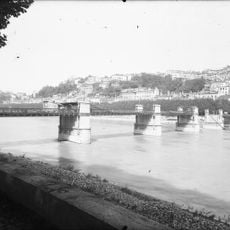
A first bridge on this site, the pont Louis-Philippe, was built in 1846 and renamed pont Saint-Clair in 1848. Rebuilt in 1856 after the 1854 flood, it became the pont Vaïsse on 21 December 1931. Once the Croix-Rousse tunnel was completed in 1952, the pont Vaïsse was demolished in 1953 and replaced in 1956 by the present bridge, aligned with the tunnel and named for Jean de Lattre de Tassigny.
The bridge is named after Jean de Lattre de Tassigny (1889-1952), a French hero of the Second World War, Companion of the Liberation and posthumously made Marshal of France. The municipal council gave the new bridge his name on 28 January 1952, before it was even built.
The bridge is accessible daily for all users and provides a reliable crossing over the river regardless of weather or season. Both vehicles and pedestrians or cyclists find safe passage with clearly defined spaces for each.
The nickname "Egyptian Bridge" belonged to the earlier Pont Louis-Philippe on this site, not to the present concrete span. The current bridge, 150 m long and 25 m wide, was aligned with the Croix-Rousse tunnel and opened in 1956. Since the tunnel's 2013 renovation, a two-way cycle lane runs along its north side, separated from the roadway by a stone border.
The community of curious travelers
AroundUs brings together thousands of curated places, local tips, and hidden gems, enriched daily by 93,643 contributors worldwide.