Porte de Roubaix, City gate in Lille, France
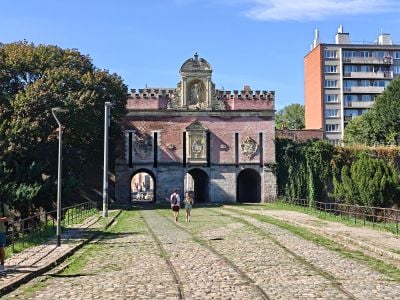
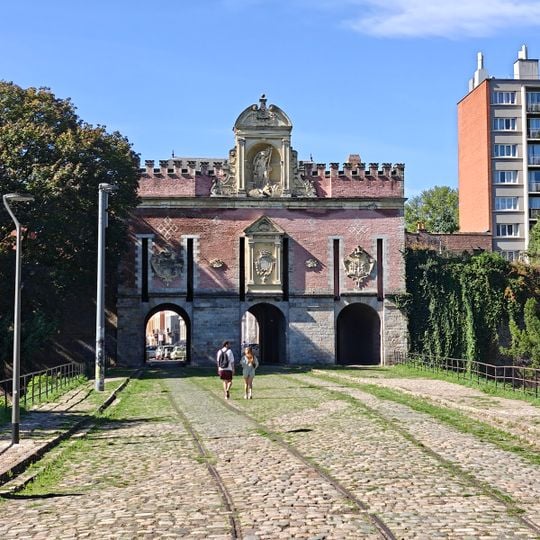
The Porte de Roubaix is a city gate in Lille with a stone base pierced by three round-headed arches: a central carriage opening and two pedestrian passages added in 1875. Above, the red brick facade carries four white stone crosses and three niches with gilded crests, the central one crowned. A crenellated brick parapet with stone coping tops the structure, and a gilded panel with a standing figure holding a staff sits at the centre.
Built in 1620 by master masons Michel Watrelos and Jean Lesur, the gate was inaugurated in 1625 as part of Lille's Spanish wall (1617–1621). It replaced the Porte des Reignaux and was later reinforced by Vauban from 1668. In 1792 an Austrian major brought the Duke of Saxe-Teschen's ultimatum to the besieged city here. Two side arches were pierced in 1875 for tram line F, and the gate was classified as a monument historique in 1929.
The gate takes its name from the road to Roubaix and is also called Porte Saint-Maurice after the parish it served. Its outer face keeps the slots where the drawbridge arms sat, and the inner face is laid in polychrome brick in a chevron pattern with stone edging around the windows.
The gate is easy to reach on foot, with metro stations and bus stops within easy walking distance. It sits at a busy street intersection, so visiting during daytime hours gives the best view and safest access.
The gate was pierced with two side arches in 1875 for line F of the tramway, and in 2004 it was fully renovated for Lille 2004. Since the mid-1990s it has been closed to motor traffic, which was moved to avenue Le Corbusier, but pedestrians still pass through toward the Parc Henri Matisse and Euralille.
The community of curious travelers
AroundUs brings together thousands of curated places, local tips, and hidden gems, enriched daily by 93,861 contributors worldwide.