Rivière souterraine de Labouiche, Subterranean river in Vernajoul, France.
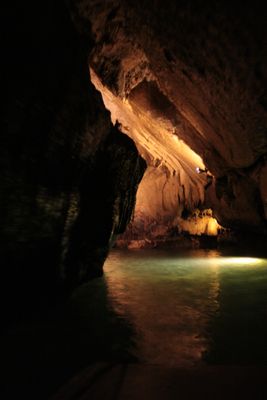
The Rivière souterraine de Labouiche is a 3,850 m cave network on the Vernajoul and Baulou boundary, 6 km northwest of Foix. Visitors cover 1.5 km of it by boat, 60 m underground, through high and low galleries lit or left dark by design, with two boat transfers on the way. The water lies below a dark rock wall and a sloping, layered ceiling of orange and tan stone.
In August 1908 Dr Jules Dunac, a Foix doctor since 1898, discovered the river with his two sons and two young officers, reaching a first sump 280 m from the entrance called Aïgo Perdent. Exploration continued in 1909–1912 with Dr Pierre Crémadells and Édouard-Alfred Martel. In 1935 Paul Salette and Crémadells, helped by Norbert Casteret and Joseph Delteil, found 3,800 m of active network before a second sump; Salette then fitted out the cave and it opened to the public in 1938.
The entrance is called Aïgo Perdent, Occitan for "waterway". The upper galleries yielded Magdalenian portable art: engraved sandstone plaques showing a lion and deer fragments, and a bison modelled in clay. Only about 150 lion figures are known in parietal art, 120 of them in France.
The visit covers 1.5 km by boat 60 m underground, with two boat transfers along the way, so expect to step in and out of the boats. Galleries are alternately high and low, and lighting is switched on or left off by design. The entrance lies at Aïgo Perdent, 6 km northwest of Foix, on the land of Vernajoul and Baulou.
The upper galleries yielded Magdalenian portable art: engraved sandstone plaques showing a lion, deer fragments and a bison modelled in clay. Lion figures are rare in cave art, with only about 150 known, 120 of them in France.
The community of curious travelers
AroundUs brings together thousands of curated places, local tips, and hidden gems, enriched daily by 93,782 contributors worldwide.