Archeological site of Alba-la-Romaine, Ancient Roman settlement in Alba-la-Romaine, France
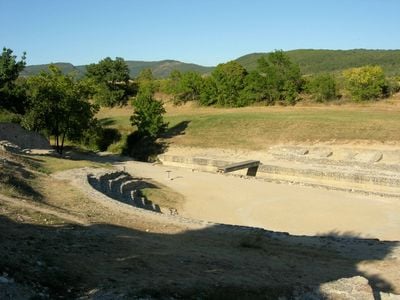
The Archaeological Site of Alba-la-Romaine preserves the remains of the Gallo-Roman city of Alba Helviorum, capital of the Helvii. The ancient city covered thirty hectares, bounded by the Saint-Martin and Saint-Pierre necropolises, with a perimeter of about four kilometres. Visitors see low foundation walls, a flat sandy arena bordered by straight stone walls, and curved tiers of stone seating forming a small semicircular theatre. Rectangular mortared blocks form a raised stepped structure in the foreground.
Alba was the capital of the Helvii, a Celtic people allied with Rome after the consul Fabius Maximus defeated the Arverni in 121 BC. The settlement grew under Augustus (27 BC–AD 14) and peaked in the 2nd century, when a 3,000-seat theatre was built. The city declined at the end of the 3rd century and was abandoned in the 4th in favour of Viviers.
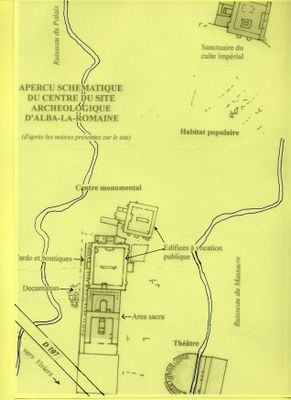
The sacred area holds two temples built in a row, with a south portico decorated with marble veneers, soft limestone columns and a geometric floor mosaic. A temple with a vestibule and a large cella stands at the centre of the courtyard. In 1992 a statue of a deified emperor was found north of the city, linked to the centre by a processional route.
Walking through the site is straightforward, with signage to guide you between different excavated areas. Interpretive panels along the paths help you understand what you are looking at in each part.
The theatre seated 3,000 spectators and was built between the mid-2nd and mid-3rd century AD. In 1992 a statue of a deified emperor was found to the north, linked to the city centre by a monumental processional route. The forum area, now under vineyard, yielded a sarcophagus naming four drapers and boatmen tied to the wine trade.
The community of curious travelers
AroundUs brings together thousands of curated places, local tips, and hidden gems, enriched daily by 94,466 contributors worldwide.