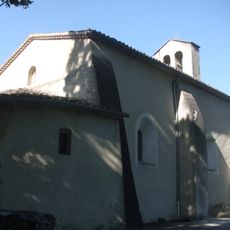
Neck de Sceautres, Volcanic neck in the Coiron massif, Ardèche, France.
Neck de Sceautres is a basaltic plug, the hardened feeder of an eruption 8 million years ago, rising 150 metres above the valley in the Coiron massif. Erosion has freed it from the surrounding rock, leaving an ovoid hill whose base is wrapped in a sheath of ash, breccia and lapilli up to 50 metres thick. The river cut its bed into these ejected deposits. On the right flank, halfway up, stone buildings with grey walls and pitched roofs stand on a terrace.
The neck is the eroded feeder pipe of a Strombolian eruption that occurred about 8 million years ago, later followed by Hawaiian-type activity. Erosion of the surrounding rock and of the ash, breccia and lapilli sheath, up to 50 metres thick, left the basalt plug standing 150 metres above the valley. The river cut its bed into these projection deposits at the base.
The name "neck" comes from the geological term for solidified lava filling a volcano's conduit, exposed here after erosion removed the surrounding rock. The village of Sceautres lies below the peak, and the basalt outcrop is a landmark of the Coiron massif in the Ardèche. The eruption that formed it was Strombolian, later followed by Hawaiian-type activity.
Marked trails lead to the summit, offering views across other volcanic formations on the plateau. Wear sturdy shoes with good grip since the basalt surface can be slippery, especially after rain.
The neck is not a column but an ovoid volcanic plug, 150 m high, ringed at its base by a sheath of ash, breccias and lapilli up to 50 m thick. The river cut its bed into these ejected deposits, so the soft layers around the basalt are as telling as the rock itself.
The community of curious travelers
AroundUs brings together thousands of curated places, local tips, and hidden gems, enriched daily by 94,713 contributors worldwide.