Tintignac, Gallo-Roman archaeological complex in Naves, France.
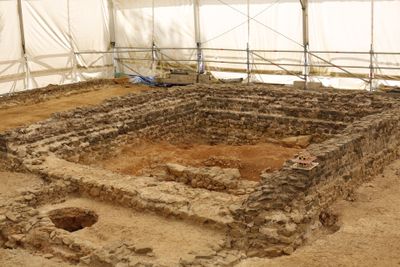
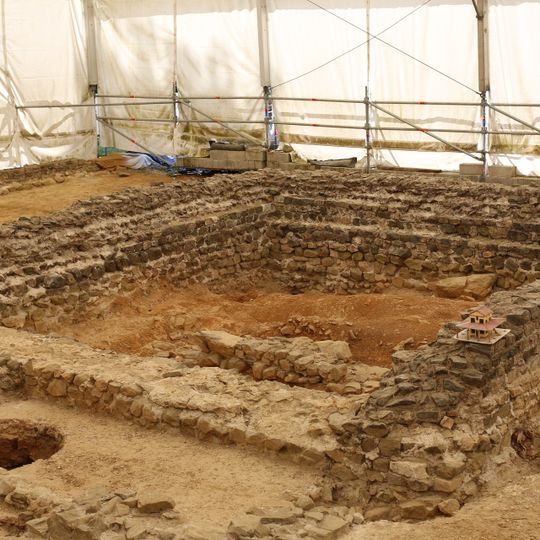
Tintignac is an archaeological complex featuring Roman structures including a temple with dual chambers and a theater nestled between two hills at about 500 meters elevation. Excavations have revealed multiple layers showing how the site evolved and was used across several centuries.
Tintignac began as a Gallic sanctuary with a sacred area enclosed by a palisade open to the east, and a wooden building rebuilt several times at its centre. In the Gallo-Roman period two fana were built over it, later enlarged into a temple with two cellae; a portico and a semicircular building followed from the first half of the 2nd century, then a theatre holding up to 2,500 people. The site was deliberately burned in the 4th century, possibly by early evangelisers.
The name Tintignac comes from the Occitan Tintinhac, recorded in the 12th century and linked to the troubadour Arnaut de Tintinhac, four of whose poems survive. The site is still wrongly called the "Arènes de Tintignac" because Étienne Baluze pictured the semicircular building as an arena.
The site is open for visits from June through September and sits just 250 meters from the A89 highway exit for easy access. Guided tours organized by the Tintignac Association are recommended to fully understand the structures and discoveries on display.
The 2004 find came from a single Gallic pit holding about 500 iron and bronze fragments: a dozen swords and scabbards, ten bronze helmets, a shield, spearheads, a cauldron and seven carnyces, one nearly complete. It was the first such deposit found in a Gallic sanctuary context.
The community of curious travelers
AroundUs brings together thousands of curated places, local tips, and hidden gems, enriched daily by 92,904 contributors worldwide.