Commanderie Saint-Jean, Romanesque tower in Nancy, France
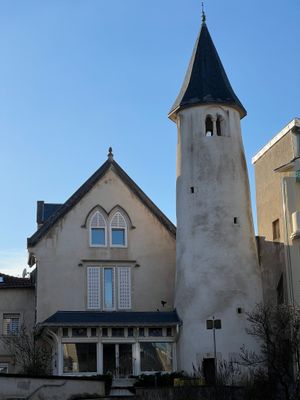
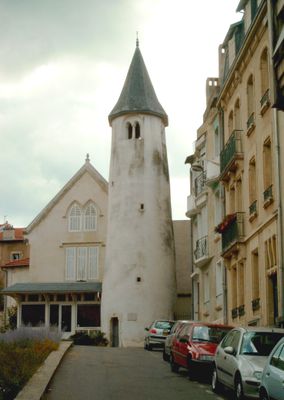
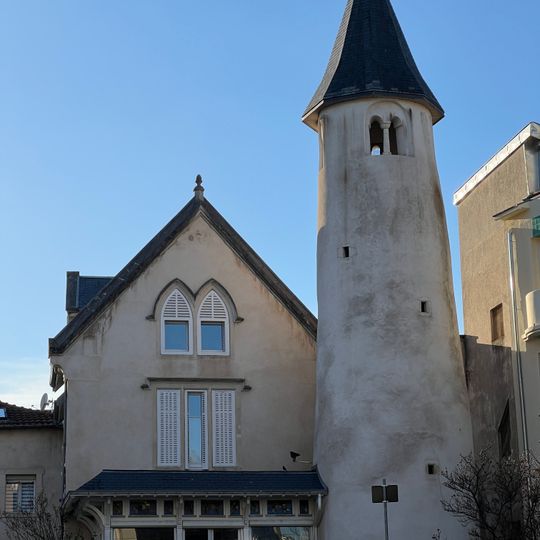
Commanderie Saint-Jean is the surviving bell tower of a 12th-century Romanesque church founded by Duke Matthew I of Lorraine, now standing at 84 impasse Clérin off Avenue Foch. The cylindrical tower is built of pale, heavily weathered stone or render, topped by a steep conical grey slate roof. Just below the roofline sit two narrow arched openings side by side, with three small square recesses spaced vertically further down; a plain dark door and a small square stone plaque mark the base.
The commandery was founded in 1140 in open country near the Saint-Jean pond, between Laxou and Nancy, and its tower is the surviving bell tower of a church founded by Duke Matthew I. In 1147 he granted the Hospitallers of Saint John of Jerusalem lands, a mill, an oven and the right of punazs, a levy of one thirty-second of grain sales at the Nancy markets, confirmed by Duke Simon in 1190 and renewed by Henry II in 1603 until replaced by a tax in 1732. Charles the Bold used the site as his headquarters during the siege of Nancy from October 1476 to January 1477. Partly destroyed in 1633 under Louis XIII, sold as national property in 1795, the buildings were demolished in the mid-19th century except the tower, listed on 19 January 1927.
The name Vieil Aître means "old cemetery", recalling a Merovingian burial ground on the site. In the 18th century the foire Saint-Jean, or cherry fair, was held at the foot of the tower, with crowds in makeshift taverns listening to ballad singers; Yves-Dominique Collin engraved the scene with the tower, a dovecote and merchants' stalls along a lime-tree walk.
The tower stands at 84 impasse Clérin, a small dead-end off avenue Foch west of the centre, near place de la Commanderie and the Laxou boundary. It is a private-looking vestige with no interior visit; the exterior, including the slate cone and the plaque beside the door, is seen from the lane. The site lies outside the old ducal walls, so allow for a suburban walk rather than a city-centre stop.
The tower is the last remnant of a church founded by Duke Matthew I and destroyed in the mid-19th century; the other commandery buildings were absorbed into 19th-century urban extensions before being demolished. The name "Vieil Aître" means old cemetery, recalling a Merovingian burial ground on the site. The tower was listed as a monument historique on 19 January 1927 and has belonged to the city of Nancy since 1950.
The community of curious travelers
AroundUs brings together thousands of curated places, local tips, and hidden gems, enriched daily by 92,853 contributors worldwide.