Villa Gillet, Historic villa in Croix-Rousse district, Lyon, France
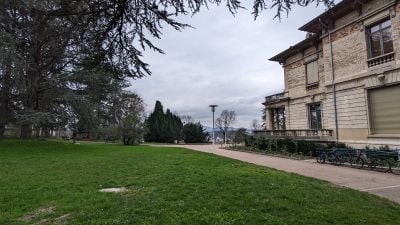
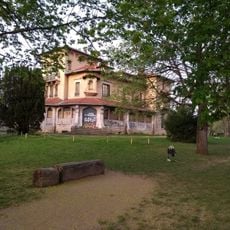
Villa Gillet is a two-storey stone villa built in 1912 by Lyon architect Joseph Folléa, set in the parc de la Cerisaie. Its pale banded ashlar facade has a projecting upper loggia with an arch and balustrade on the left, a carved frieze band above the ground floor, and a small balustraded terrace on the right over a recessed porch. Three dormer windows and brick chimneys sit on the dark tiled roof, and broad stone steps with curved side walls climb the grassy slope to the house.
The Gillet family, dyeing industrialists who later helped found what became Rhône-Poulenc, had the villa built in 1912 by the Lyon architect Joseph Folléa. From 1853 they had sought land for their works, and from 1880 their dyehouse on the quai de Serin produced the "flottes en noir". The villa stood on the heights above those factories. Paul Gillet's heirs sold it to the city of Lyon in 1976, and it was listed as a monument historique in 2015.
The villa now operates as an international center for contemporary writing, hosting literary festivals, author readings, and cultural discussions throughout the year. Visitors encounter writers and participate in conversations about current literary topics.
The villa stands in the parc de la Cerisaie, above the old dye works on the Saône quays. Public events take place in the Théâtre and the salons, but many are also held in partner venues across Lyon and Auvergne-Rhône-Alpes, so check the venue before setting out. The programme runs from September to July.
The animal frieze above the ground floor was painted in 1913 by Louis Bardey (1851-1915), not part of the original 1912 construction by Joseph Folléa. The villa was sold to the city of Lyon in 1976 after the death of Paul Gillet, and it was listed as a monument historique in 2015.
The community of curious travelers
AroundUs brings together thousands of curated places, local tips, and hidden gems, enriched daily by 92,841 contributors worldwide.