Villa Paradiso, 19th-century villa in Cimiez district, Nice, France
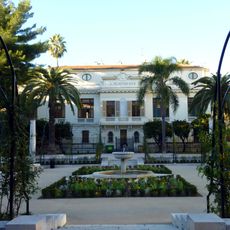
Villa Paradiso is a 19th-century residential estate in the Cimiez district that blends Italian villa design with French mansion features. The building displays a western loggia and modified Mansard roof that showcase how these two architectural styles were merged together.
Lucien Barbet built the villa in 1881-1882 for the businessman Adolphe Sicard, director of the Caisse de crédit de Nice. Around 1900 it was bought by Baroness Hélène de Zuylen de Nyevelt de Haar, and Constantin Scala carried out alterations after 1900. Didier Gayraud instead dates the present building to 1896, built for Baron Étienne van Zuylen van Nyevelt on the site of Sicard's villa. In 1918 Louis Feuillade filmed episodes 1-3 of Tih Minh here, renaming it villa Circé.
The villa's name is tied to its role as a refuge for the Prix de Rome: from November 1941 to May 1944, under mayor Jean Médecin and academic Maurice Mignon, its outbuildings and stables were converted into studios for laureates such as architect Bernard Zehrfuss and painter Pierre-Robert Lucas. After the war the city kept six of these studios for selected artists, among them sculptor Marcel Mayer and painter Raymond Moretti in 1959.
The villa stands at the foot of the Cimiez district, roughly 200 metres east of the Musée Marc Chagall, within grounds of about 1.6 hectares. The garden includes a children's playground and an outdoor amphitheatre added after the war. The building now houses the city's central education department, so the interior is not open as a museum; the grounds and the three-arched loggia facade are what a passer-by can see.
From 1957 to 2006, an international summer school operated here each year, attracting students from many different countries. This academy turned the building into an important venue for artistic and scholarly training in the region.
The community of curious travelers
AroundUs brings together thousands of curated places, local tips, and hidden gems, enriched daily by 93,850 contributors worldwide.