Villa Victoria, Cultural heritage villa in Cannes, France
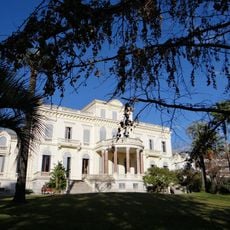
Villa Victoria is a villa at 7 avenue du Docteur-Raymond-Picaud, in the La Croix-des-Gardes district of Cannes, built in 1852-1853 in a 15th-century English rustic style. Its facade of rough grey and brown stone blocks has pale stone quoins at the corners; on the upper level an arched window with blue and white leaded panes opens onto a projecting balcony with a pale stone balustrade of pierced latticework. Below, a pointed Gothic-arched doorway framed in pale stone holds a dark green door with two white pointed panels, flanked by carved figures: a winged creature above on the left and a small human figure on the right. A black lantern hangs left of the door, with lower windows and a green potted plant at ground level.
Sir Thomas Robinson Woolfield had the villa built in 1852–1853 in a 15th-century English rustic style, designed by architect Thomas Smith and erected by masonry contractor Odadhia Pulhan. Augustus Murray, of the Dunmore family, bought it in 1877 and added a wing that doubled its floor area. In 1952 Cannes architects Louis Lafond and Eugène Lizero converted it into a condominium of apartments.
The villa's name honours Queen Victoria, and its grounds were laid out by the English gardener John Taylor, newly arrived from England, as a pleasure garden with exotic trees and a vegetable plot. The park drew illustrious visitors and was written up in the Journal of Horticulture and Cottage Gardener. In 1874 the British gentry of Cannes came here to try lawn tennis on the coast's first court, a sport Major Walter Wingfield had invented the year before.
The villa stands at 7 avenue du Docteur-Raymond-Picaud in the La Croix-des-Gardes district of Cannes. It was divided into apartments in 1952, so the building is private and not open to visitors; the gardens and facade are what can be seen from outside. The site is listed in the general inventory of cultural heritage.
In 1874 Thomas Robinson Woolfield installed the first tennis court on the Côte d'Azur in the villa's grounds, where British gentry came to try the sport invented the previous year by Major Walter Wingfield. The garden, laid out by John Taylor, was noted in the Journal of Horticulture and Cottage Gardener for its exotic trees and plants.
The community of curious travelers
AroundUs brings together thousands of curated places, local tips, and hidden gems, enriched daily by 93,714 contributors worldwide.