Villa Vivios, Gallo-Roman villa in Lespignan, France
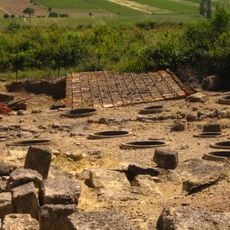
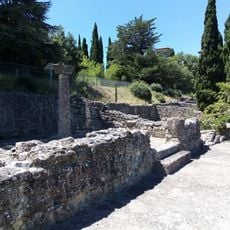
Villa Vivios is a Gallo-Roman villa in Lespignan, Hérault, whose remains include a thermal complex with a large pool and canals, plus a poorly preserved mosaic near the entrance. Low ruined walls of pale greyish-white stone and masonry, broken into irregular segments and standing about waist height, cross the ground; the surrounding surface is a coarse mosaic of small grey, white, beige and reddish-brown stones scattered with fragments and pine needles.
Villa Vivios is a Gallo-Roman villa in Lespignan, Hérault. Official excavations were led by J. Giry and B. Pauillac in campaigns between 1969 and 1982, then again from 1986 to 1989. Finds from the dumps, especially those of the large pool, are kept in the museums of Nissan and Ensérune rather than in Lespignan. A multidisciplinary study of the site began in 2018.
The name Vivios may derive from the Latin bivium, a fork in the road, or from Viviers, an 18th-century name for a nearby path; it has also been linked to a gentilicium of the Biterrois. Finds from the dumps, especially those from the large pool, are kept in the museums of Nissan and Ensérune rather than in Lespignan.
The remains lie in the Lespignan countryside, with no facilities, restrooms or marked visitor route on site. Excavations between 1969 and 1982, then 1986 to 1989, left the large pool and canals exposed to vegetation, and illegal digging has damaged the masonry. Bring water and wear closed shoes; the ground is rough and overgrown.
The name Vivios is linked to a gentilicium of the Biterrois, the Roman name stock of the Béziers area, rather than to a road fork. Other explanations point to the Latin bivium, a bifurcation, or to Viviers, an 18th-century name for a neighbouring path.
The community of curious travelers
AroundUs brings together thousands of curated places, local tips, and hidden gems, enriched daily by 94,658 contributors worldwide.