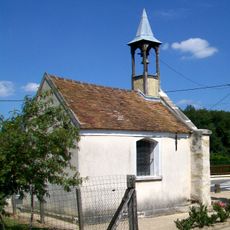
Église Saint-Georges de Belloy-en-France, Gothic church in Belloy-en-France, France.
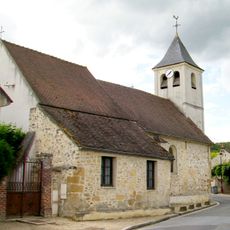
The Église Saint-Georges is built of light beige and grey ashlar, with a central pointed-arch portal framed by fluted Corinthian columns and a triangular pediment carved with an arabesque frieze and an angel holding a scroll. A square tower with a dark slate spire rises beside the facade, and two tall pointed-arch windows sit between buttresses on the south wall. Inside, the three-bay nave and its side aisles are the same width, carried on clustered piers with leaf capitals.
A charter of 840 records a basilica of Saint George at Belloy, then called Bidolidum, proving the parish's early existence. The oldest surviving parts are the Romanesque bell tower piers and the north transept with its apse, from the second half of the 12th century. The main apse and south apse followed in the 14th century, and the de Belloy family funded the Renaissance west facade in the 16th century. A keystone in the north aisle bears the date 1598 and the family's coat of arms.
The parish keeps the Tridentine rite: Mass is said in Latin according to the 1962 missal of John XXIII, and communion is received kneeling at the choir grille. The high altar remains at the back of the sanctuary, as the liturgical reform of Vatican II was not applied here. The parish is now a grouping that also includes Villaines-sous-Bois and Villiers-le-Sec.
The church stands on Place Sainte-Beuve, the village centre, reached by the rue Faubert; the square surrounds the building, but the area behind it to the north is often closed by gates. In that case only the west facade, the south elevation, the Sainte-Geneviève chapel and the choir are visible, plus part of the Vierge chapel. Sunday Mass is celebrated at 11:00 in the Tridentine rite.
The church keeps the engraved slab of Guillaume de Belloy (died 4 September 1556) and his wife Antoinette de Perthuis (died 1552), both shown in low relief inside a French inscription asking visitors to pray for their souls. The family funded the 16th-century building work, and a keystone in the north aisle carries their coat of arms and the year 1598.
The community of curious travelers
AroundUs brings together thousands of curated places, local tips, and hidden gems, enriched daily by 93,144 contributors worldwide.