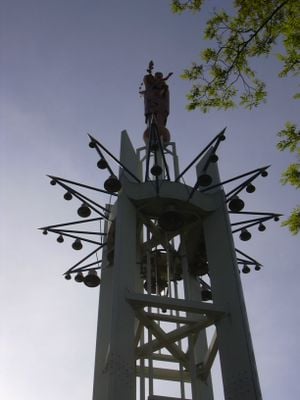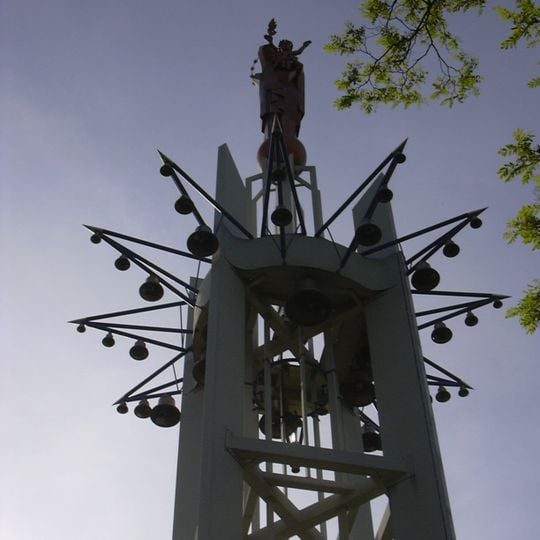
Statue de Notre-Dame de France, Copper statue at Notre-Dame-de-France oratory, Baillet-en-France, France
The Statue de Notre-Dame de France is a copper statue in Baillet-en-France, north of Paris, depicting the Virgin Mary holding the infant Jesus. It stands on a tall stone pedestal and is clearly visible from the road nearby.
Roger de Villiers designed the gilded copper statue, forged by Raymond Subes, for the pontifical pavilion of the 1937 Paris World's Fair, where it was titled "La Vierge portant haut l'Enfant les bras ouverts sur le monde". Kept one more year as the Pavillon Marial, it was taken down on 2 November 1938. Cardinal Verdier wanted it on a hill near Paris, but war and his death in 1940 ended the plan. In 1959 it was placed atop the church of Saint-Honoré in Amiens, then removed in 1982 because of cracks and stored in a school basement. Notary Edmond Fricoteaux, after a 1984 conversion in Rome, tracked it down; 25,000 subscribers funded its restoration at the Quesnel workshop in Corbie, and it was installed at Baillet-en-France in October 1988.
The statue is a Marian pilgrimage site where believers from the region come to pray. Visitors can see candles, flowers, and small personal offerings left at the base of the pedestal.
The site is north of Paris and easy to reach by car, as the statue is visible from the road. Access is free throughout the day and visitors can walk right up to the monument for a closer look.
The statue was inspired by the Virgin on the Notre-Dame de France centre in Jerusalem, built by Assumptionist religious at the end of the 19th century. Its original title at the 1937 fair was "La Vierge portant haut l'Enfant les bras ouverts sur le monde".
The community of curious travelers
AroundUs brings together thousands of curated places, local tips, and hidden gems, enriched daily by 94,256 contributors worldwide.