Église Saint-Géry, Classical church in Cambrai, France.
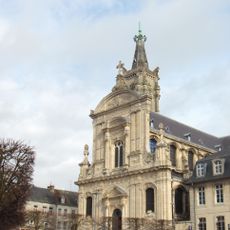
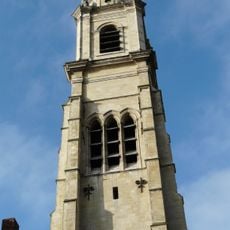
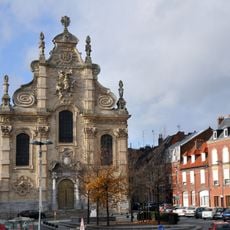
Église Saint-Géry is a church in Cambrai built from 1648 to 1745 under the direction of Antoine Caby, combining Renaissance and classical styles. Its pale stone facade has round-arched windows framed by pilasters and cornices, and a tall central tower with a square shaft, clock stage, octagonal belfry and slender spire. The building stands partly behind trees and a black fence.
The building grew from an abbey founded in the 7th century and underwent major reconstruction at the end of the 17th century. The current name was adopted between 1802 and 1804, marking a shift in the site's identity and purpose.
The church has been dedicated to Saint Géry, the founding bishop of the Cambrai diocese, since 1804; before that it was the abbey church of Saint-Aubert. Its organ, built by Merklin in 1867, was rebuilt in 1978 by René Godefroy in an 18th-century Nordic classical style with 41 stops on three manuals. The former high altar of Vaucelles Abbey is kept here.
The church is open for visitors during the day, though one should be respectful during active services when the community gathers. It is best to visit outside of service times to view the interior artworks and architectural details without distraction.
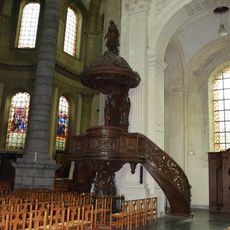
The polychrome marble jubé is attributed to Gaspard Marsy, born in Cambrai in 1624, and was moved from the transept to beneath the organ loft in 1738. Rubens brought his Entombment of Christ here himself in 1616, travelling from Antwerp via Lille and Aniche; an unknown Antwerp painter later painted a loincloth over the figure, and Rubens reportedly slashed the canvas with a dagger when he saw it.
The community of curious travelers
AroundUs brings together thousands of curated places, local tips, and hidden gems, enriched daily by 93,667 contributors worldwide.