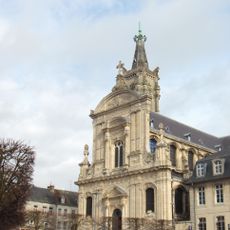
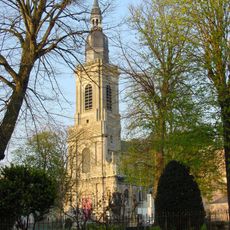
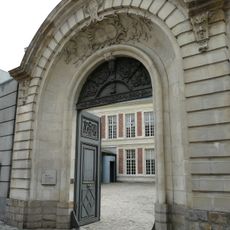
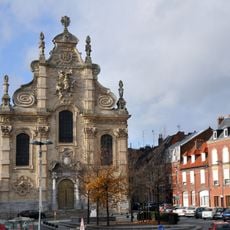
Belfry of Cambrai, Gothic bell tower in Cambrai, France
The Belfry of Cambrai is a Gothic bell tower built between 1447 and 1474, rising about 62 metres in light beige masonry. Projecting ledges divide it into stages; near the top a small square stage holds a round-arched louvered opening, and below it three tall pointed-arch windows sit side by side. Four sculptures carved in 1922 by Marcel Gaumont stand at the corners.
The tower's origins trace back to the 11th century, with significant reconstructions occurring through the 13th century. In 1395, Emperor Venceslas granted official authorization, establishing its formal status within the city.
Cambrai's watchmen, called gallus after the Latin word for rooster, kept lookout from a chamber in the dome. They announced enemy troops, fires, the opening and closing of the town gates, and the curfew, ringing the hours and half-hours; two were on duty from 9 pm to 6 am. The last two, Saliege and Caudron, served until 1934, when the bells were electrified.
The tower is closed to the public because of its staircase, so it cannot be climbed and there is no interior visit. It is best seen from the outside, from the streets and squares around it, where the full height of about 62 metres can be taken in. Look up at the corner sculptures added in 1922 by Marcel Gaumont.
The four corner statues date from 1922, carved by Marcel Gaumont, a Prix de Rome winner. They depict a Frankish chief, a town militia archer, Louise of Savoy, who signed the Paix des Dames in 1529, and the Marquis de Cézen, first governor of Cambrai after Louis XIV took the city. They replaced earlier figures reduced to shapeless masses by the 1920 fire.
The community of curious travelers
AroundUs brings together thousands of curated places, local tips, and hidden gems, enriched daily by 94,108 contributors worldwide.