Église Saint-Sauveur de Saorge, Historical church in Saorge, France
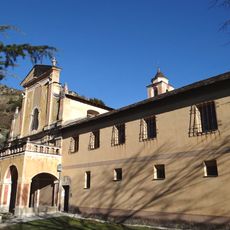
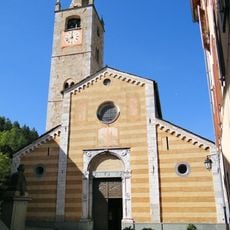
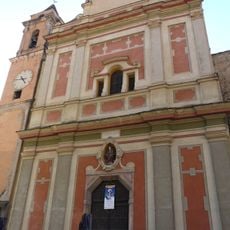
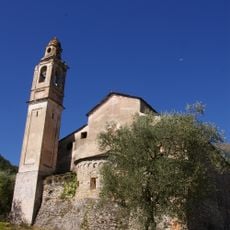
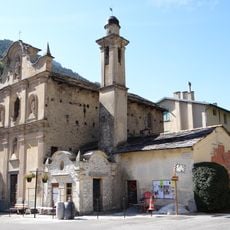
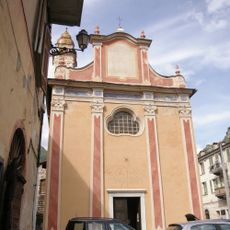
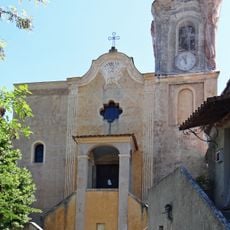
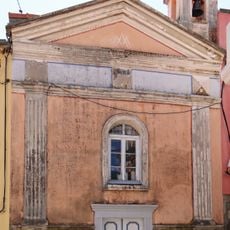
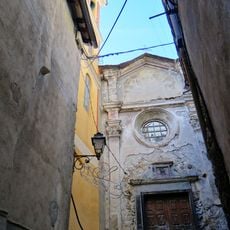
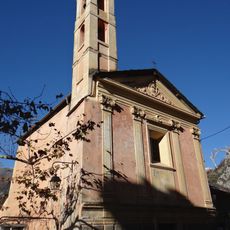
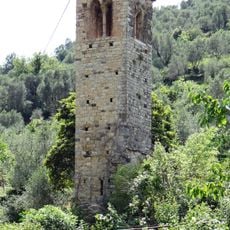
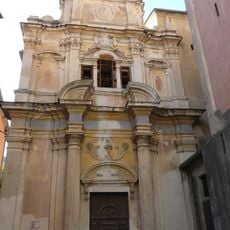
The Église Saint-Sauveur de Saorge is a Catholic church in the Alpes-Maritimes, its pale ochre and tan plaster peeling to reveal grey stone. The main facade has a shallow gabled roof, a dark quatrefoil window high up, and a tall arched doorway with dark wooden double doors and a small oval plaque. A square bell tower built in 1812 carries a tiled bulbous cupola and four bells cast in Nice in 1803 and 1834.
The church, first dedicated to Saint Anthony, stood on the present site until a major fire destroyed it in 1465. Villagers rebuilt it around 1500 and dedicated it to the Holy Saviour. Saorge's prosperity in the 17th century, when the town counted 22 notaries in 1610, brought most of its altars. The square bell tower was added in 1812, and the building was classified as a monument historique in 1981.
The church keeps the mark of Saorge's 17th-century notary wealth: most of its side altars were founded then, among them the altar of Saint Joseph, endowed in 1639 by the lawyer Thomas Toesca, which holds the church's older tabernacle of 1539. The altar of Saint Eloi, patron of the village's muleteers, already existed in 1642.
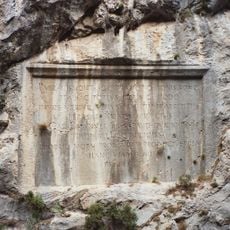
The church stands in the village of Saorge in the Alpes-Maritimes; the lateral wall carries a Roman inscription set into the stone near the side door, and the main portal shows two pilasters and a lintel with the paschal lamb. The square bell tower, built in 1812, is topped by a bulbous cupola covered in polychrome tiles.
The organ arrived from Pavia by boat at Nice, was registered at the customs toll office on 16 August 1847, then carried up to Saorge on mules and received in the church on 20 September 1847. It kept its original case, enlarged and deepened from the 1739 instrument, and was inaugurated after restoration in 1979 by René Saorgin.
The community of curious travelers
AroundUs brings together thousands of curated places, local tips, and hidden gems, enriched daily by 94,658 contributors worldwide.