Église Saint-Symphorien d'Avignon, Gothic parish church in central Avignon, France.
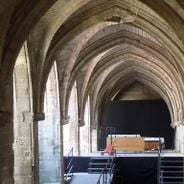
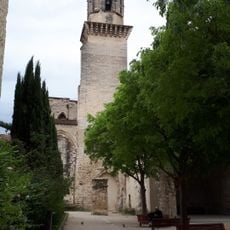
Église Saint-Symphorien d'Avignon is a single-nave Gothic church on Place des Carmes, seven bays long with two rows of seven non-communicating side chapels. Its flat ashlar facade has a small rose window with a star-pattern stone lattice above a pointed-arch portal. The interior vault, built in brick in 1836, covers a wide nave; the organ loft at the rear holds a dark wood case of silver pipes.
The Grands Carmes settled outside Avignon's walls in 1267 and built their convent and church. Jean XXII launched a reconstruction in 1320, funded on by Clément VI, and the conventual church was consecrated on 10 April 1520. After a collapse on 20 May 1672 left only the facade, choir and side chapels, rebuilding lasted over six years and the church was re-blessed on 9 July 1678.
The church takes its name from Saint Symphorien, whose martyrdom is depicted in four canvases attributed to Guillaume-Ernest Grève, probably from 1602, and in an Apotheosis of Saint Symphorien by Philippe Sauvan (1780). These five paintings came from the earlier parish church of Saint-Symphorien, demolished in 1803, whose functions and name were transferred here.
The church stands on the Place des Carmes in the eastern part of Avignon's walled centre, a short walk from the Rue Carreterie. Enter from the square through the main pointed portal; the nave and its side chapels open directly off the central aisle. The organ loft is at the rear of the nave, above the entrance.
The 1672 collapse spared only the facade, choir and side chapels; rebuilding took over six years and the church was re-blessed on 9 July 1678. The nave then stood under an exposed timber roof until 1836, when the present brick barrel vault with lunettes was built.
The community of curious travelers
AroundUs brings together thousands of curated places, local tips, and hidden gems, enriched daily by 93,004 contributors worldwide.